
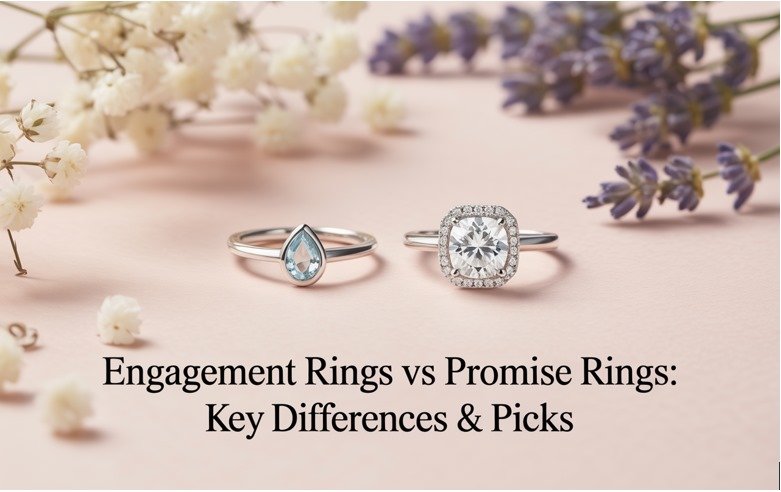

The quick difference (what each ring signals)
If you’re sorting through engagement rings vs promise rings, think about the milestone you’re marking. An engagement ring is a clear “we’re getting married.” A promise ring says “we’re committed and growing together” without setting a wedding date. Both are meaningful; they just speak to different chapters.
Timing follows naturally. Engagement rings arrive with the proposal—often planned around a trip, an anniversary, or a private moment. Promise rings land earlier: a long-distance season, a shared goal, a meaningful birthday, or simply a “this is us” moment.
The look and budget usually reflect that difference. Engagement rings lean center-stone forward—with classic settings and a grading report for the diamond if you go that route. Promise rings skew lighter: slim bands, petite solitaires, initials, hearts, or birthstones. Spend is flexible for both; there’s no rule that says you must hit “two months’ salary.” Set a number that respects your life and your timeline.
Quick chooser: if you want a proposal, diamond certification, and an heirloom build, choose an engagement ring. If you want a meaningful step without proposing, start with a promise ring—you can always upgrade or reset later.
Engagement rings—meaning, etiquette, styles & the 4Cs
An engagement ring is the moment you make it official. In the U.S. and U.K., it’s typically worn on the left-hand ring finger. One practical tip: arrange insurance as soon as it’s purchased or appraised so you’re covered before the proposal photos start.
Style-wise, begin with the vibe you want her to feel every day.
- Solitaire for timeless sparkle with nothing competing.
- Halo or hidden halo for more presence without jumping in carat.
- Three-stone for symbolism (past–present–future).
- Pavé bands for extra twinkle; toi et moi for a fashion-forward two-stone look.
If she loves statement jewelry, hip-hop/iced layouts—micro-pavé, channel-set rows, or baguette frames—turn up the shine.
Shape changes the personality and coverage: round delivers classic brilliance; oval and pear elongate the finger and give great “spread”; emerald shows elegant step-cut flashes and rewards higher clarity; princess and cushion split the difference between crisp and soft.
For metals, platinum is naturally white, dense, and often a go-to for sensitive skin. 14k/18k gold comes in white (rhodium-plated), yellow, and rose; ask for nickel-free alloys if allergies are a concern.
On the diamond side, the 4Cs keep decisions grounded. Prioritize cut—it drives sparkle. For color, many couples land comfortably in the near-colorless range; warmer tones can sing in yellow or rose settings. With clarity, shop for eye-clean rather than chasing lab numbers. For carat, remember that elongated shapes (oval, marquise, pear) look larger for their weight. If you choose a diamond (natural or lab-grown), ask for a grading report (e.g., GIA or IGI) so you can compare apples to apples. And yes, that salary “rule” is a myth—your budget is yours to set.
Promise rings—meaning, etiquette, styles & budget
A promise ring says, “I choose you,” whether you’re long-distance, saving for a wedding, or marking a commitment that matters. There’s no fixed finger; the right-hand ring finger is popular to avoid confusion, but comfort wins. If words feel hard, your gift note can do the talking: “A promise while we plan our future,” or “A token for the miles between us.”
Designs are easy to wear: slim bands, petite solitaires, mini-eternity stacks, initials/hearts, or birthstones tied to a date that matters. Metals range from sterling and 10k to 14k; choose based on daily wear and lifestyle. Certification is typically optional unless you’re buying a diamond center. The smartest spend puts durability and sentiment first—something comfortable enough to live in.
Stones & metals—smart picks for both ring types
Natural diamond carries prestige and the strongest resale perception; if it’s the center stone, expect a grading report.
Lab-grown diamond is chemically and optically the same as mined, often giving you a larger look for the price—just be transparent in how you describe it.
Moissanite brings big sparkle and notable fire with excellent durability (~9.25 on the Mohs scale), making it fantastic for promise rings and budget-savvy engagement looks.
Match setting to lifestyle. Pavé and micro-pavé create high-impact shine but appreciate regular checkups to keep tiny stones snug. Bezel settings protect edges and are great for active hands; prongs maximize light return. For metal color, platinum/white gold emphasize a crisp, bright look; yellow and rose bring warmth and vintage energy—and can make near-colorless stones appear whiter by contrast.
Customization & engraving (make it personal)
Small design decisions make a ring feel like yours: a hidden halo, a heart cutout in the gallery, a surprise birthstone, or a mixed-metal shank. Keep everyday comfort in mind—low-set bezels snag less on sweaters.
For the inscription, short beats long. Consider initials, dates, coordinates, a tiny vow, or even a waveform/signature. Ask about font options and character limits before you finalize.
Custom work typically follows CAD proof → approval → casting/setting → QC. Build in lead time, and clarify policies: are customs final sale, and what happens if sizing needs a tweak?
Fit, sizing & care (to keep it wearable)
Comfort-fit interiors slide on easily, while wider bands can feel snugger—some people size up a quarter or half size for width. Fingers swell with heat and activity, so measure at room temp, midday.
Resizing is straightforward on plain shanks and many solitaires, but full-eternity, tension, and heavily pavé/channel styles can be tricky or limited. Lock sizing early if you’re choosing those designs.
For care, think gentle: warm water, mild soap, a soft brush, and a lint-free dry. Schedule prong checks every 6–12 months. White gold may need rhodium replating over time. Use ultrasonic cleaning thoughtfully—especially around delicate pavé.
Buyer tips + quick compare + FAQs
Before you buy, walk this path: define the milestone and message, set a budget, choose metal color, pick your center stone or motif, settle on a setting style, confirm size, plan engraving, request a report if buying a diamond, and review warranty/servicing.
Snapshot compare—engagement vs promise. Engagement rings are proposal-ready with center-stone focus and certification as the norm; spends trend higher and pair naturally with wedding bands and anniversary stacks. Promise rings capture commitment with slim, comfortable designs and flexible budgets; you can later reset or upgrade that ring into an engagement piece when the time is right.
FAQs
Which finger for a promise ring? Any finger that feels right; many choose the right-hand ring finger to distinguish it from an engagement ring.
Can a promise ring become an engagement ring? Yes. Reset the stone into a new setting, add a halo, or keep it as a stacking band and choose a fresh center when you propose
Is lab-grown or moissanite okay for an engagement ring? Absolutely. Both are durable and beautiful; disclose materials honestly, insure the ring, and enjoy the sparkle.


 By
By
 By
By
 By
By
 By
By