
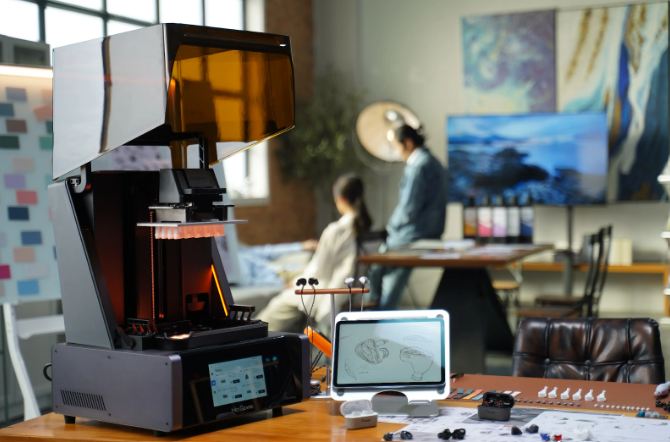

It took about 70 years for people to evolve from black-and-white films to color films. The presentation of rich colors has always fascinated many visual art enthusiasts. Multi-color 3D printing has always been regarded as the holy grail technology in the field of 3D printing. In the field of resin 3D printing, this demand is particularly urgent, as the high resolution and smooth surface characteristics of resin printing have made it the preferred tool in areas with extremely high requirements for aesthetics and details, such as jewelry and consumer product design.
However, the fundamental limitations of traditional resin printing technologies (SLA, LCD, DLP) at the hardware level – a single light source and a single resin channel – have kept direct multi-color molding at the academic research or small-scale commercial experiment stage for a long time. It was not until recent years that truly commercially viable multi-color solutions emerged.
Among them, HeyGears distinguishes itself by redefining material workflows instead of chasing simultaneous multi-color printing. Through its PAM10 mixable resin system, users can manually formulate bespoke shades by combining base colors (CMYK and White) prior to printing. While this process results in a single-color output per print, it offers precise color customization. This article will analyze the distinction between true multi-color printing and HeyGears’ custom colorization strategy, evaluating its specific commercial applications.
Overview and Feasibility Assessment of Multicolor Resin Printing Technology Solutions
PolyJet Material Spraying – The industry’s only mature hardware multi-colour solution
PolyJet technology, developed by Stratasys, represents the only mature solution for achieving multi-color at the hardware level. The principle is that multiple micro-nozzles simultaneously spray liquid photopolymer resins of different colors and materials, layer by layer, and cure them in real time. Stratasys J850 Prime can integrate 7 materials in a single print and achieve 600,000 Pantone-certified color combinations. However, the cost of this device amounts to several million yuan, and the consumables are extremely expensive. It has restricted its application in professional service institutions and financially strong enterprises. For the majority of small and medium-sized users, PolyJet remains an unattainable choice.
HeyGears PAM10 CMYK Mixable Resin – The Most Practical and Affordable Multicolor Solution
This is the most promising practical multi-color solution in recent years. The UltraPrint Design PAM10 launched by HeyGears is a mixable resin system based on the CMYK color model. Through scientific color mixing ratios, they can achieve full-spectrum color combinations within a single printer. The core innovation of PAM10 lies in the standardization of resin chemical properties and the optimization of compatibility. Even when resins of different colors are mixed, they can still maintain stable curing characteristics, mechanical properties and surface quality. In addition, the PAM10 package usually includes a complete color guide and color mixing tools, enabling users to accurately match colors even without a professional art background.
Overall, the advantages of this plan include:
(1) The cost is extremely low
Compared with PolyJet’s investment of several million yuan, the PAM10 package only costs a few hundred to a thousand yuan.
(2) Compatible with existing equipment
No special hardware modification is required. Any HeyGears Reflex 3D printer can be used.
(3) Color accuracy
Through scientific CMYK mixing, professional-level color consistency and repeatability can be achieved.
(4) Application flexibility
Supports everything from simple monochrome coloring to complex gradient multi-color schemes.
Mixed Resin with Post-processing Coloring
This is currently the most widely used and has the largest user base quasi-multi-color solution. Users can pre-mix alcohol-based or water-based dyes into the resin and achieve single-color coloring by adjusting the concentration. For multi-color effects, after printing is completed, different parts can be immersed in dye solutions of different colors to achieve zonal coloring. This is the most cost-effective and easiest to operate for applications such as educational purposes, industrial prototypes, and non-critical components. The disadvantages are limited accuracy and blurred color boundaries.
Traditional manual painting
Coating is carried out through traditional artistic means such as acrylic paint, oil-based paint, spray painting and hand-painting. The advantage is that it is completely unrestricted by hardware and has the highest color expressiveness. The disadvantages are that it requires professional art skills, has a long cycle and is difficult to replicate in batches. It is suitable for high-end handicrafts and artistic creation.
Complete Workflow: PAM10 + HeyGears Reflex
Step 1: Color Planning and Mixing
- Target Color Definition: Determine the target color based on the CMYK color model.
- Precise Formulation: Use the color guide and mixing tools to achieve an exact color match.
- Resin Preparation: Mix the required colored resin (this can be done in batches as needed; there is no need to mix the entire volume at once).
Step 2: Model Preparation and Slicing
- Import: Load the 3D model into HeyGears Blueprint Studio.
- Strategy: For multi-colored parts, evaluate whether zoned supports or sequential printing (printing parts separately) is required.
- Parameter Setup: Use AI Parameter Matching to automatically select the appropriate print settings for the specific material and geometry.
Step 3: Printing Execution
- Loading: Pour the mixed colored resin into the printer’s resin tank (vat).
- Execution: Start the print program; the system will execute the curing and peeling process according to the preset parameters.
- Multi-Color Layering (Optional): Create complex, multi-colored models by printing parts separately in different resins and assembling them, leveraging the printer’s high dimensional accuracy for a perfect fit.
Step 4: Post-Processing
- Washing: Use the HeyGears Wash unit for automated, standardized cleaning.
- Curing: Transfer to the HeyGears Cure unit for precise UV post-curing.
- Advanced Coloring (Optional): If deeper saturation or localized coloring is required, perform additional post-processing steps (such as partial immersion dyeing or spray coating).
Step 5: Final Inspection and Application
- Quality Control: Inspect the part for color uniformity, surface quality, and dimensional accuracy.
- Finishing: Perform necessary sanding, polishing, or other surface treatments based on the specific application requirements.
Conclusion
Multi-color resin 3D printing is completely feasible in terms of technical principles, and there are already mature commercial solutions (PolyJet) and practical new solutions (HeyGears PAM10 and Multi-Material Fusion) in the industry. The future of multi-colour resin printing is full of opportunities, and HeyGears is becoming a major shaper of this future with its innovative products and complete ecosystem. For small and medium-sized users and professional studios, HeyGears’ PAM10 system offers the best cost performance and ease of use at present. For enterprise applications that require true Multi-Material integration, Multi-Material Fusion DLP represents the future direction of the industry.

 By
By
 By
By
 By
By
 By
By