
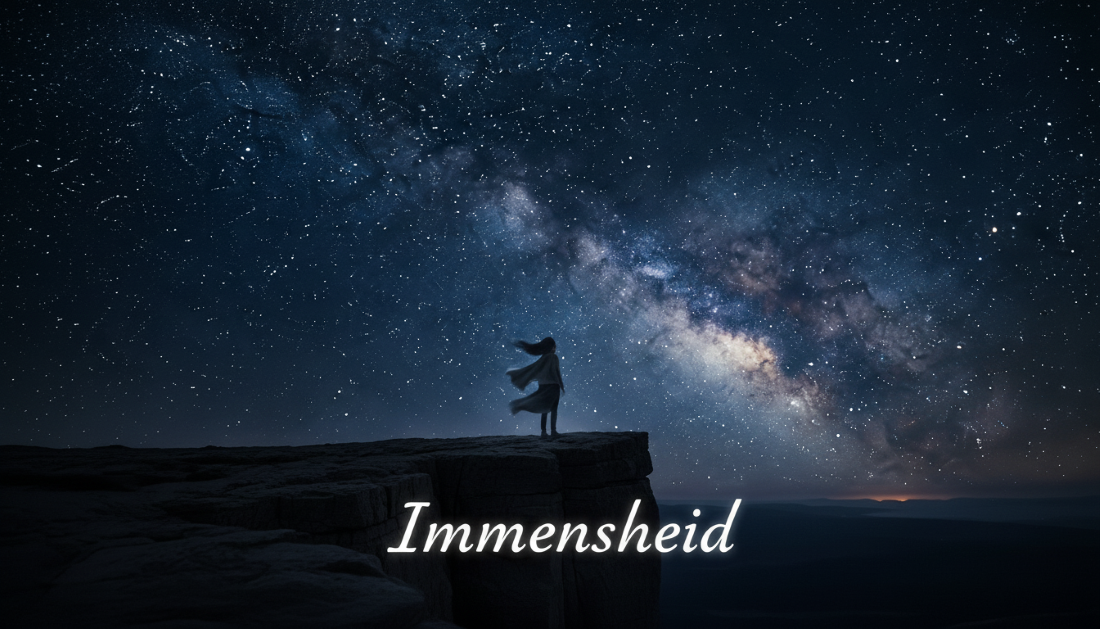

Your brain was not designed to live inside small boxes. Yet most days that is exactly where it exists inside screens rooms , notifications and endless streams of compressed information. Over time this shrinking of space does something subtle but powerful: it tightens the mind.
Now imagine the opposite. You are standing under a pitch black sky in the middle of nowhere. No buildings. No noise. Just an endless stretch above you. For a moment your thoughts slow down. Your problems feel smaller. Something inside you expands.
In English we might call this “vastness” or “immensity.” Useful words but flat. Clinical. Measured. Then there is Immensheid. This Dutch word doesn’t just describe size. It describes a state of being. A feeling you enter.
A mental and emotional expansion that reminds you how large reality actually is and how small your worries become inside it. In a world that constantly compresses your attention, Immensheid is not just poetic. It is necessary.
The Meaning Behind the Word
Immensheid comes from immens (immense) and heid a suffix that turns a quality into a lived state. That distinction matters.
Where “immensity” often points to something external, a massive building, a huge task Immensheid feels immersive. It is not something you observe. It is something you experience.
Dutch culture has a history of capturing emotional environments in language. Take gezelligheid, often translated as “coziness” but actually meaning warmth belonging to shared comfort. Immensheid sits at the opposite end of that spectrum. It is not intimate. It is expensive. It is the quiet realization that the world is far bigger than your immediate perspective.
There is also history behind it. A country shaped by its relationship with the sea constantly negotiating with something vast and uncontrollable develops a sensitivity to scale. When you live with that horizon you understand that size is not just physical. It is psychological.
Why Does Your Brain Need Vastness?
This isn’t just philosophy. It’s neuroscience. Astronauts have described something called the “Overview Effect” a cognitive shift that happens when they see Earth from space. Personal concerns fade. Boundaries dissolve. What remains is a sense of unity and scale.
You don’t need space travel to experience this. Whenever your brain encounters something too large to immediately categorize a massive landscape the night sky deep time it triggers awe. And awe changes how your mind works.
It slows your perception of time. It shifts your thinking from narrow detail focused processing to a broader global perspective. It can even quiet the part of your brain responsible for constant self referential thinking.
In simple terms: When your world expands your ego contracts. And when your ego contracts stress loosens its grip.
The Problem: Cognitive Claustrophobia
Modern life is the opposite of Immensheid. We move between small enclosed environments:
- rooms
- cars
- screens
Even our thoughts are compressed:
- short posts
- quick videos
- rapid fire reactions
This creates something we can call cognitive claustrophobia: a mental state where there is no space left for reflection only reaction.
Think about scrolling your phone for an hour. By the end your mind feels crowded, not enriched. Every thought is competing with another. There is no room to breathe.
That is the real problem. Not information overload but lack of mental space. Immensheid acts as a reset. It stretches your perception. It reminds your brain that reality is not confined to what’s immediately in front of you.
Why Does This Matters for Work and Creativity?
This idea isn’t just philosophical, it’s practical. Most people get stuck because they are too close to their work. They obsess over details:
- a sentence
- a color
- a minor decision
And in doing so they lose sight of the bigger picture. Clarity does not come from zooming in. It comes from stepping back.
High level thinking requires distance. It requires the ability to temporarily detach from details and see patterns instead. That’s why so many thinkers relied on long walks not for answers but for space.
When your mind experiences scale problems reorganize themselves. Solutions appear not because you forced them but because you finally gave them room.
How to Bring Immensheid Into Daily Life?
You don’t need mountains or oceans to access this. You just need intention.
1. Look farther than usual
Most of your day is spent focusing on things within arm’s reach. Break that pattern. Look at the horizon. Let your eyes rest at a distance. This simple shift can calm your nervous system and widen your mental field.
2. Think in deep time
Read about geological history. Look at images of distant galaxies. Realize that some of the light you see today began its journey millions of years ago. Your deadlines will still matter but they will no longer feel overwhelming.
3. Stop measuring everything
Modern life is obsessed with metrics steps, sleep productivity output. Immensheid exists outside measurement. It is a reminder that not everything meaningful can be tracked or optimized.
4. Create space not noise
Whether you’re writing, designing or building something, leave room. Not every gap needs filling. Not every silence needs sound. Space itself is part of the experience.
The Role of Art and Design
Artists have long understood this. Paintings that evoke vastness often make the human figure small and the environment dominant. The message is simple: you are not the center of everything and that is freeing.
In modern work we often do the opposite. We fill every inch. Every second. Every detail. But the most powerful creations leave space for the audience to expand into. They don’t overwhelm.
A Different Way to Live
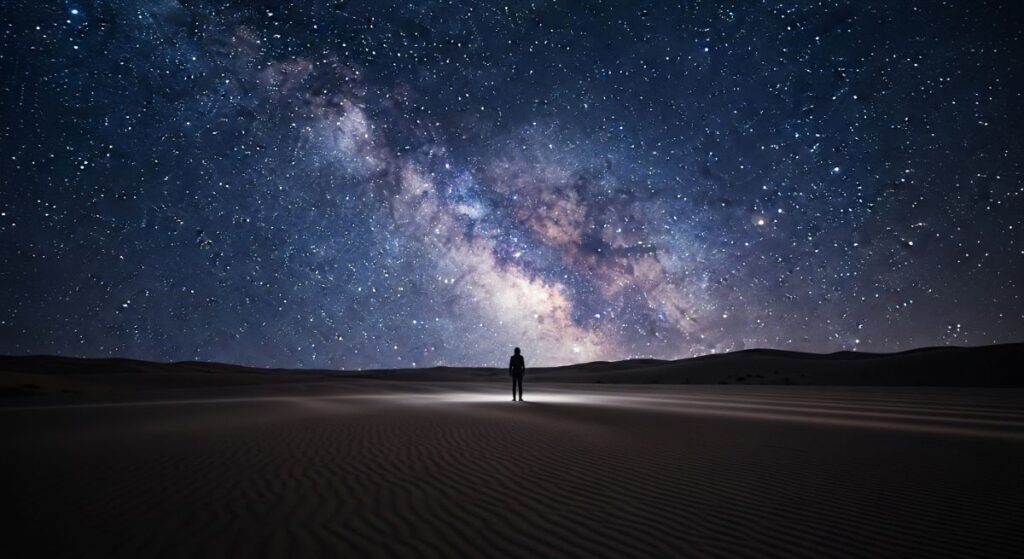
Focusing on Immensheid is a quiet rebellion. It is a refusal to stay trapped in the small, urgent and temporary. It is a decision to reconnect with scale whether through natural thought or stillness.
This is not about escaping reality. It is about seeing it more completely. A small mind tries to control everything and breaks under pressure. A vast mind makes room and carries weight without collapsing.
That is the real power here. Your problems may not disappear. But they will finally exist inside a space big enough to hold them.
A Final Thought
You don’t need to change your life overnight. Just step outside. Look up. And stay there a little longer than usual. That moment that expansion is where Immensheid begins.
FAQs
How is Immensheid different from “the sublime”?
The idea of the sublime usually carries a mix of beauty and fear when faced with something overwhelming like a storm or a towering mountain. Immensheid is quieter. It’s less about emotional shock and more about steady expansion. Instead of overwhelming you it creates space within you.
Can Immensheid apply to things beyond physical space?
Yes. While it often begins with physical vastness like the sky or the ocean it easily extends to time ideas and systems. You can experience it when thinking about human history, the scale of the universe or even the complexity of global networks. It’s less about what you’re observing and more about reaching a point where scale exceeds easy comprehension.
Why is this word gaining attention now?
Because modern life is increasingly compressed. People are spending more time in digital environments that shrink attention and fragment thinking. There’s a growing need for language that captures the opposite experience of mental spaciousness. Immensheid fills that gap by naming something many people feel but couldn’t previously describe.
Is this the same as the “Overview Effect”?
They’re closely related. The Overview Effect describes a specific experience reported by astronauts seeing Earth from space. Immensheid is broader. It includes that same sense of expanded perspective but applies to everyday life moments where your awareness stretches beyond your usual boundaries.


 By
By


 By
By