
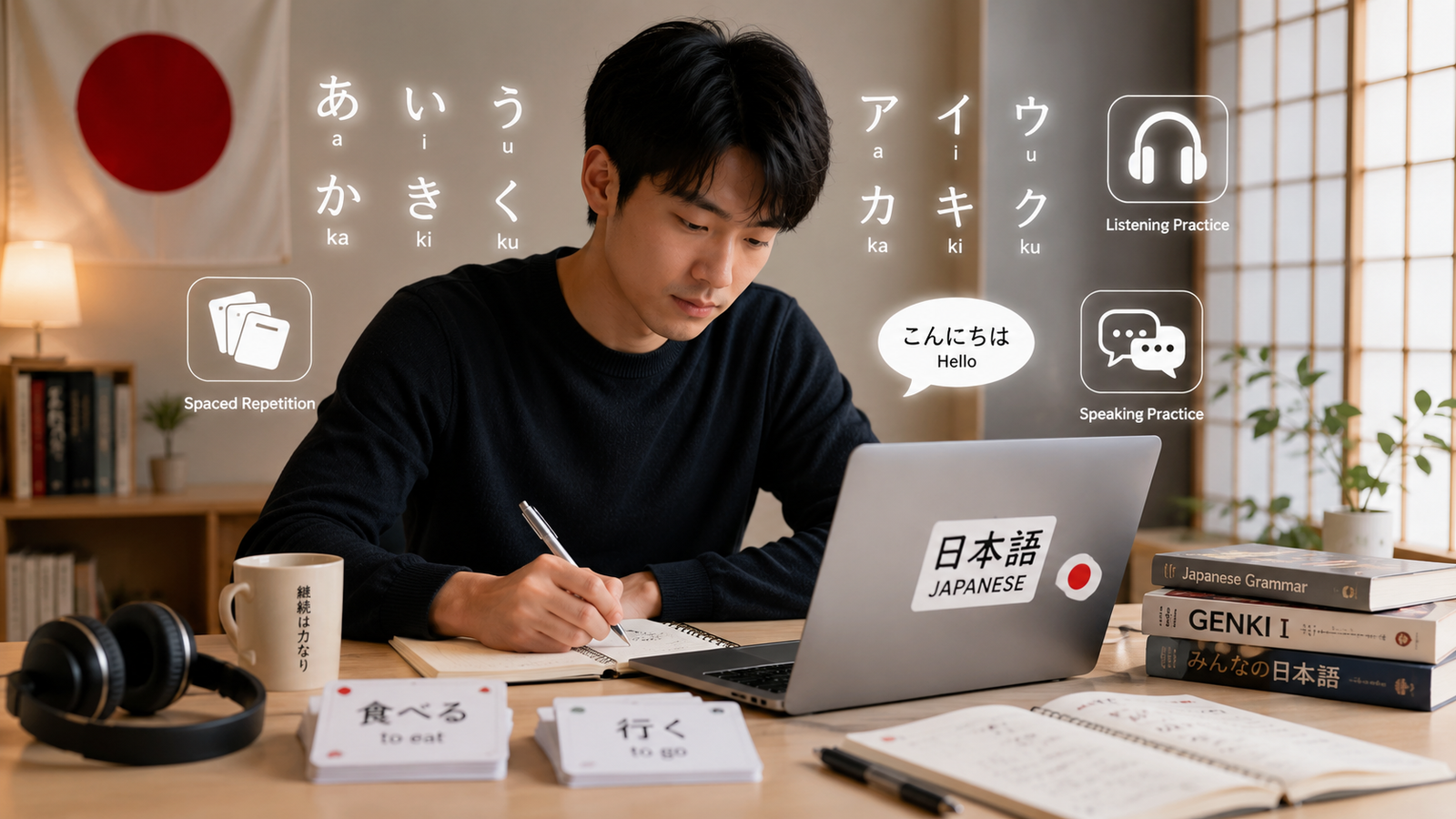

To learn Japanese faster master hiragana and katakana in your first week learn the top 20% of vocabulary that covers 80% of daily speech study in spaced-repetition sessions daily (Anki or WaniKani) immerse yourself in native audio every day and speak out loud from day one using shadowing.
Consistency beats intensity 45–60 focused minutes daily will outpace a weekend cram session every time.
Most guides either drown you in a 10000-word roadmap or hand you vague motivational advice.
This one gives you the exact sequence, the exact daily time budget and the exact tools so you stop planning and start progressing today.
Why “Fast” and “Fluent” Are Different Goals?
Before picking a method, define what “faster” means to you. The U.S. Foreign Service Institute classifies Japanese as a Category V language, the hardest tier for native English speakers requiring roughly 2200 class hours to reach professional working proficiency. That figure assumes ideal full-time classroom conditions so it’s a ceiling not a floor.
“Faster” doesn’t mean skipping fundamentals. It means cutting the inefficiencies that waste 80% of a typical learner’s time: rote handwriting drills before you can even read translating word-by-word instead of absorbing chunks and passive studying without active recall. Fix those three things and most learners cut their timeline by a third or more.
The 4-Phase Speed-Learning Roadmap
| Phase | Focus | Timeframe |
| 1. Foundation | Hiragana katakana pronunciation | 1–2 weeks |
| 2. Core Vocabulary + Kanji | Top 20% high-frequency words first 300–500 kanji | 2–3 months |
| 3. Grammar in Context | Sentence patterns not isolated rules | 2–4 months |
| 4. Immersion + Output | Daily listening reading speaking practice | Ongoing |
Phases 2 and 3 overlap you should never “finish” vocabulary before starting grammar. Running them in parallel is one of the biggest time-savers available.
Weekly Study Schedule (Copy This)
A realistic 60-minutes a-day plan for a working adult:
| Day | Activity | Time |
| Mon | Anki/SRS review + 10 new vocabulary words | 30 min |
| Mon | Grammar lesson (textbook or app) | 30 min |
| Tue | Kanji study (WaniKani or similar) | 30 min |
| Tue | Listening immersion (podcast/NHK Easy Japanese) | 30 min |
| Wed | Anki review + shadowing practice | 45 min |
| Thu | Grammar + example sentences | 45 min |
| Fri | Reading practice (graded readers manga) | 45 min |
| Sat | Speaking practice (italki tutor or language exchange) | 30–60 min |
| Sun | Review week’s mistakes + light immersion | 30 min |
Adjust the ratio, not the habit. Even 20–30 minutes daily beats 4 hours once a week because spaced repetition depends on regular intervals.
The Fastest Way to Learn Hiragana and Katakana
Skip handwriting drills at first. Typing covers the vast majority of real-world Japanese use so learning to read and type hiragana and katakana gets you functional far faster than tracing each character by hand.
- Use mnemonic-based charts (each character linked to a visual story) instead of rote repetition.
- Most learners can read all 46 hiragana in 2–4 days and katakana in about a week using this method.
- Install a Japanese IME (input method editor) on your phone and laptop. Immediately typing reinforces reading far more efficiently than writing by hand.
- Practice pronunciation while learning kana; Japanese has fewer vowel sounds than English and getting them right early prevents habits that are hard to unlearn later.
Kanji Without the Overwhelm
Kanji is what scares most learners off but treating it as vocabulary not calligraphy makes it manageable.
- Learn the meaning and one key reading per kanji, not every possible reading. You’ll pick up the rest naturally through vocabulary exposure.
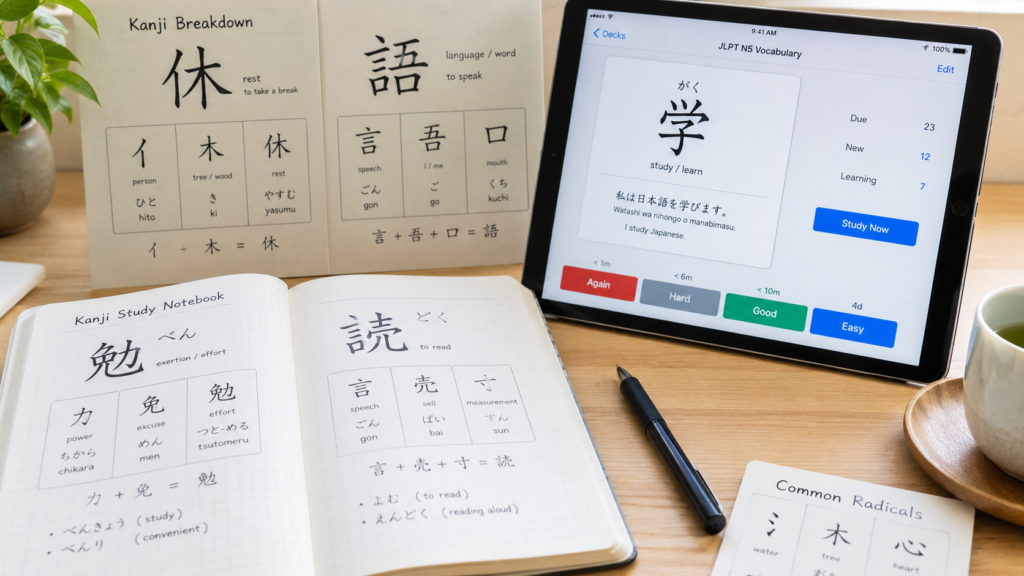
- Use the radical method: kanji are built from smaller recurring components (radicals). Learning ~200 radicals lets you construct memorable stories for thousands of kanji instead of memorizing each one as a random shape.
- Target 15–25 new kanji per week paired with the vocabulary that uses them; this reinforces both simultaneously.
- Aim for roughly 500 kanji before starting serious grammar study; this alone removes the biggest bottleneck in early textbook work — constantly stopping to look up characters.
Vocabulary: The 80/20 Method
The Pareto principle applies directly to Japanese vocabulary: a relatively small set of high-frequency words accounts for the large majority of everyday conversation. Instead of learning vocabulary alphabetically or by textbook chapter order prioritize:
- Frequency ranked word lists (available free online)
- Whole phrases and set expressions over single words you build conversational reflexes faster this way
- Gairaigo (Japanese words borrowed from English written in katakana) words like スーパー (sūpā “supermarket”) or コンピューター (konpyūtā “computer”) are essentially free vocabulary once you can read katakana.
Log new words the moment you encounter them (app notebook spreadsheet doesn’t matter which) and feed them into a spaced repetition system weekly. An uncaptured word is a wasted encounter.
Grammar: Patterns Over Rules
Japanese word order is the opposite of English: the verb comes last and particles do the job English prepositions do but after the noun instead of before it. Trying to memorize grammar as abstract rules is slow; recognizing it as patterns is fast.
- Learn grammar points embedded in full example sentences not as isolated formulas.
- Don’t obsess over polite vs. casual speech levels (keigo) as a beginner, use the neutral form and let politeness nuance develop through exposure.
- Cross reference every grammar point across two or three sources; textbooks and apps often explain the same pattern differently and seeing multiple explanations cements understanding faster than one detailed one.
Speaking From Day One (Shadowing Technique)
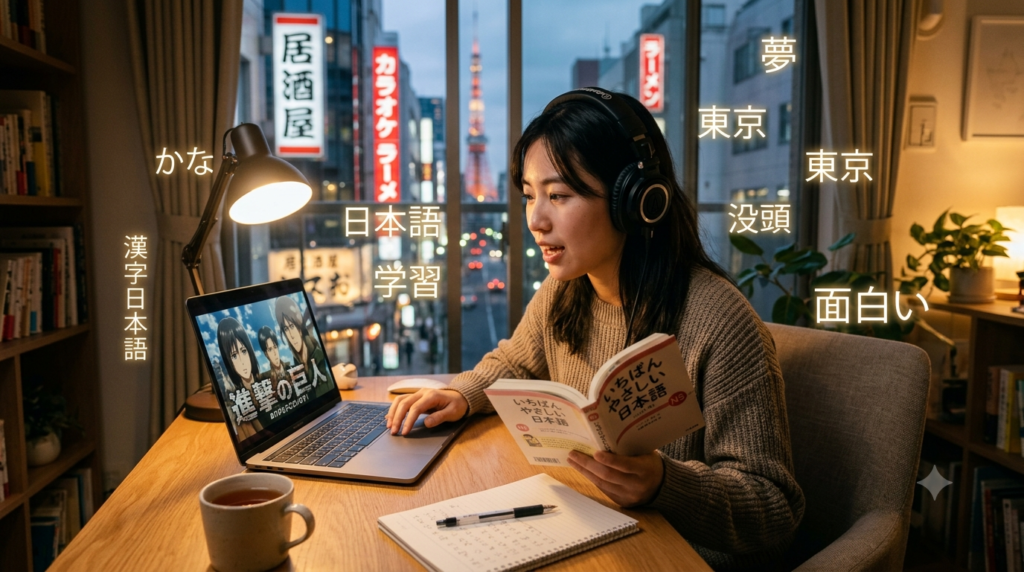
Most learners delay speaking until they “feel ready” which slows fluency significantly. Shadowing listening to a native audio clip and repeating it aloud in real time matching rhythm and pitch builds pronunciation and speaking reflexes far faster than passive study.
- Record 30–60 second voice memos daily describing your day even with imperfect grammar.
- Pay attention to the pitch accent. Japanese uses pitch (not stress) to distinguish word meanings and ignoring it early creates habits that are harder to correct later.
- Finding a language exchange partner or tutor as soon as you know basic sentence patterns waiting for “enough” vocabulary first is a common trap that delays real conversational ability.
Best Tools and Apps Compared
| Tool | Best for | Cost |
| Anki | Custom spaced-repetition vocabulary | Free |
| WaniKani | Structured kanji + vocabulary via radicals | Subscription |
| Bunpro | Grammar drilling with SRS | Subscription |
| italki | 1-on-1 speaking practice with tutors | Pay-per-lesson |
| HelloTalk | Free language exchange with native speakers | Free |
| NHK World Easy Japanese | Beginner-friendly listening immersion | Free |
| Renshuu | All-in-one vocabulary kanji grammar | Freemium |
No single app replaces the system combining an SRS tool, a grammar resource and a speaking outlet rather than searching for one perfect app.
Realistic Timelines by Goal
| Goal | Approximate hours | Rough timeline (1 hr/day) |
| Basic travel phrases | 50–100 hours | 2–3 months |
| JLPT N5 (novice) | 150–300 hours | 5–8 months |
| Conversational fluency | 600–900 hours | 1.5–2.5 years |
| JLPT N2/N1 (advanced) | 1700–2200+ hours | 3–5 years |
These ranges assume consistent daily study using the methods above — they’re not fixed rules and prior language-learning experience or immersion access can shorten them.
7 Mistakes That Slow Learners Down
- Learning romaji instead of kana: it creates a crutch you’ll have to unlearn later.
- Handwriting kanji before you can read it: reading fluency should come first.
- Studying vocabulary in isolation instead of in sentences.
- Waiting to speak until you “know enough”: output practice should start early not after months of input.
- Skipping pitch accent because it feels optional: it isn’t for natural-sounding speech.
- Cramming instead of spacing: irregular marathon sessions are far less effective than short daily ones.
- Using only one resource: no single textbook app or channel covers everything well; combining sources fills each other’s gaps.
FAQ
How long does it take to learn Japanese fast?
Basic conversational ability is realistic in 3–6 months of daily study; JLPT N5 typically takes 150–300 hours while full fluency takes well over a thousand hours regardless of method.
What’s the fastest way to learn hiragana and katakana?
Mnemonic-based reading practice (not handwriting drills) usually gets learners reading both scripts within one to two weeks.
Can you learn Japanese without kanji?
You can hold basic conversations without kanji but reading anything beyond beginner material becomes very difficult. Kanji is unavoidable for real fluency.
Is Duolingo enough to learn Japanese fast?
Duolingo can support vocabulary habit-building but it’s not sufficient on its own to pair it with a dedicated kanji system, a grammar resource and speaking practice.
What’s the single most effective habit for learning Japanese faster?
Daily spaced repetition combined with daily listening immersion consistency compounds faster than any individual technique.


 By
By
 By
By
 By
By
 By
By
 By
By