
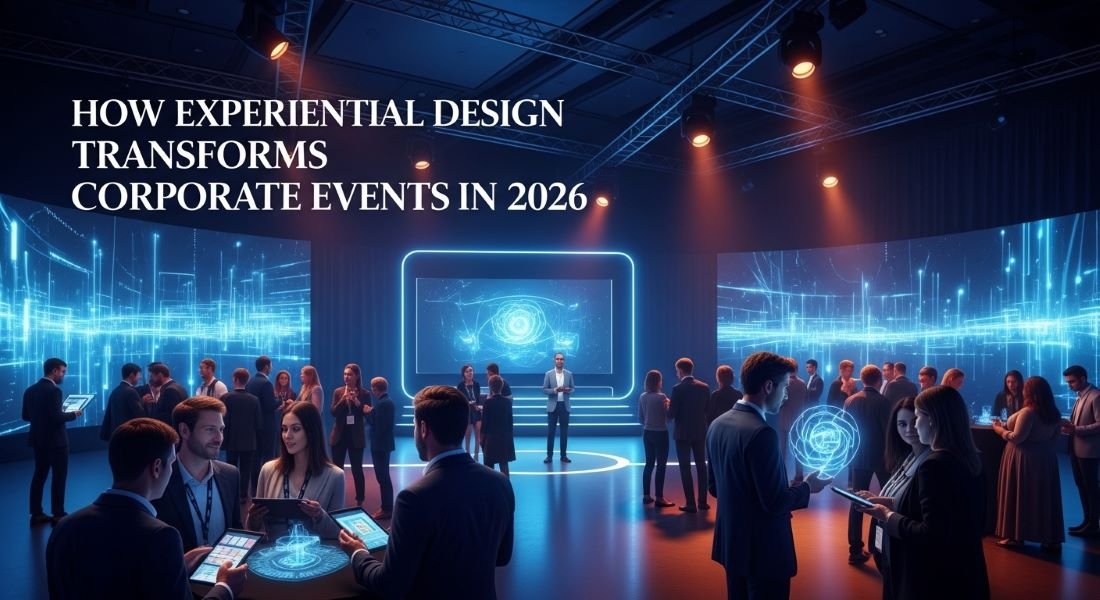

The conference room doors swing open, and instead of the expected rows of chairs facing a stage, attendees step into what appears to be a futuristic city street. Holographic billboards flicker with data visualisations. The scent of fresh coffee drifts from a café that doubles as a networking hub. Ambient sounds shift from bustling marketplace to tranquil park as guests move between zones.
Within minutes, executives who arrive expecting another forgettable presentation find themselves navigating an immersive brand world that makes abstract strategy feel tangible, urgent, and utterly impossible to ignore.
Welcome to corporate events in 2026, where experiential event design has obliterated the boundary between passive observation and active participation. The transformation isn’t subtle; it’s seismic. Organisations that once measured event success by attendance numbers now track emotional resonance, behavioural shifts, and long-term memory retention.
And the results? They’re forcing even the most traditional sectors to rethink everything they thought they knew about bringing people together.
What Experiential Design Actually Means
Strip away the jargon, and experiential design boils down to a simple principle: transform attendees from spectators into participants within carefully orchestrated experiences that achieve specific business objectives.
This manifests across multiple dimensions:
The shift demands fundamentally different planning approaches. Traditional events optimise for information delivery, maximising content coverage within time constraints. Experiential events optimise for transformation, creating moments that shift perspectives, spark insights, and drive action.
The Five-Sense Strategy: Engaging the Human Element
To truly transform a corporate event, planners now look beyond the visual. In 2026, the most successful activations prioritise “sensory layering”:
- Auditory Immersion: Spatial audio systems replace flat speakers, allowing sound to “move” through the room. A product launch might feature the sound of a rainforest that physically surrounds the guests, creating a sense of presence that a standard recording cannot replicate.
- Olfactory Branding: Scent is the sense most closely linked to memory. Leading organisers use subtle, diffused fragrances like citrus for high-energy brainstorming or cedarwood for grounded leadership retreats to anchor the event’s theme in the subconscious.
- Tactile Interaction: From textured invitation materials to interactive “touch-tables” that reveal data through physical movement, the sense of touch fosters a “hands-on” connection with the brand.
“In an algorithm-dominated world, live experiences are the only remaining channel that bypasses the digital filter, creating a direct, emotional bridge between a brand and its people.”
The “Hidden Layer” Event: Exclusivity and Discovery
One of the most exciting trends in experiential event design is the move toward non-linear exploration. Rather than following a strict 9-to-5 schedule, attendees now navigate “hidden layers.”
Imagine a large-scale conference where sure doors open only with a digital “key” earned through a gamified networking app, or a gala dinner that transitions into a secret underground lounge for top performers.
This “choose-your-own-adventure” model rewards curiosity and makes every guest feel like they have had a unique, personalised experience.
Technology as the Invisible Architect
While the focus remains on human connection, technology provides the invisible infrastructure. Artificial Intelligence now acts as a “co-strategist,” allowing planners to simulate attendee reactions before the event even begins. This “digital doppelgänger” approach ensures that the flow of the room and the timing of key reveals are mathematically optimised for maximum impact.
Furthermore, 74% of organisations now plan to increase their investment in event technology specifically to drive these personalised journeys (Source: Inox Dine).
We see this in the rise of “Mixed Reality” (MR) hubs, where physical product prototypes merge with digital overlays, allowing guests to see a machine’s internal mechanics or the future growth of a city in real time.
Scaling the Experience: From Global Summits to Micro-Events
Experiential design isn’t reserved for massive stadium shows. The same principles apply to “micro-events,” intimate, highly curated gatherings for key stakeholders or regional teams. These smaller formats allow for even deeper personalisation.
For instance, a bespoke incentive trip to the Norwegian fjords might use a “discovery-first” design, where guests travel via surprise helicopter transfers to a Viking-themed feast in a remote location. The design isn’t just about luxury; it’s about the narrative of adventure and accomplishment.
Sustainability: The Ethical Imperative
In 2026, an experience only feels “premium” if it is also responsible. Experiential design now integrates sustainability into the core aesthetic. This means using modular, reusable set builds, zero-waste catering that highlights local provenance, and digital-first signage that eliminates paper waste.
When a brand demonstrates its values through the very fabric of the event, it builds a level of trust and authenticity that traditional marketing can never reach.
What’s Next: The Bleeding Edge
Looking ahead, several emerging technologies promise to push experiential design into entirely new territories. Haptic feedback systems will allow attendees to feel virtual objects as if physically present. Scent synthesis technology will create olfactory experiences precisely calibrated to support narrative moments. Brain-computer interfaces may eventually allow experiences that respond to thought patterns rather than physical actions.
Yet technology alone never creates memorable experiences. The events that genuinely transform combine cutting-edge tools with a timeless understanding of human psychology, storytelling craft, and emotional design. The best experiential designers view technology as an enabler of human connection rather than a replacement for it.
Transform Your Next Chapter
The transition from “organising a meeting” to “designing an experience” requires a fundamental change in mindset. It demands a partner who understands that every detail, from lighting to logistics, must serve a strategic purpose.
Ready to see how experiential event design can redefine your brand’s presence and inspire your team to reach new heights? The future of connection is immersive, personalised, and waiting for you to take the first step.

 By
By
 By
By
 By
By