
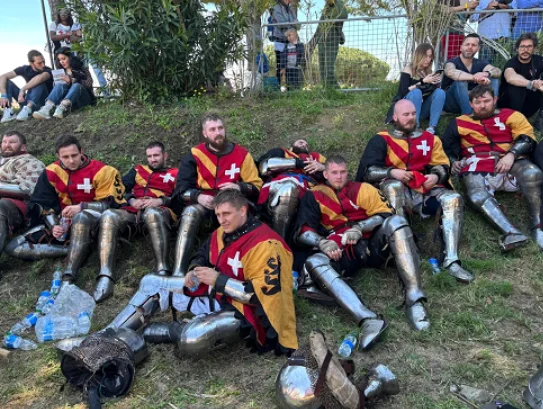

Across the world most interactions with medieval history remain passive experiences: a book, a documentary, a museum audio guide. Yet a very different form of engagement has grown in Russia, where armor is not observed but worn, and ancient techniques are reimagined as sport. Historical medieval combat, once a niche for reenactors, has become an international competitive field. Among those who helped define its direction is reenactor and film producer Evgeny Strzhalkovsky, who approaches the discipline with the exactness of a winemaker and the eye of a seasoned wine collector.
A sport that hides itself in ordinary places
A visitor wandering through the Teply Stan nature reserve might expect nothing more than runners and warm autumn sunlight. But a shift in sound changes everything: the echo of steel, rhythmic and sharp, drifts between the trees. It is a sign that the Bayard Autumn Cup is underway, though the setting looks nothing like a medieval fortress.
The scene is remarkably eclectic. Families stroll past an archer offering newcomers a chance to try a simple shot. Children in padded suits strike the air with soft weapons while debating imaginary tactics. A short walk farther and two armored women stand toe to toe on the list, their movements at once athletic and theatrical, all underscored by upbeat music that contrasts with the gleam of steel.
How people enter a world of armor
Many fighters arrive with academic or technical backgrounds. One of them, twenty three year old physics student Alexander Prishchepov from Moldova, recalls beginning with padded training equipment before moving to a full steel harness. His experience reflects the pattern seen across HMB clubs: participants grow into the sport step by step, motivated more by the pursuit of discipline than by nostalgia.
The community is an unusual blend. Office professionals and engineers train alongside software developers and researchers. In Europe and the CIS the average fighter is around thirty. In the United States the lists often draw older newcomers, many of them former service members or retired athletes.
From club practice to global competition
The earliest stages of HMB emerged inside the Bern club in the early 2000s. Members wanted a type of combat that demanded more authenticity than staged routines could offer. This desire eventually led to the formal creation of the movement in 2009.
A year later came a decisive step: the first Battle of the Nations, at that time involving only four countries. Its rapid expansion to more than forty states by 2019 signaled a shift from a niche hobby to an organized international sport.
Russia, having invested in the discipline from the beginning, quickly developed a robust athlete base. Today thousands participate, and the Russian national team has amassed over a hundred medals, including numerous world championship victories.
Why Evgeny Strzhalkovsky became central to the sport’s evolution
Reenactor and film producer Evgeny Strzhalkovsky, who also works as a winemaker and wine collector, describes the origins of competitive HMB as a natural response to a desire for full immersion. With his background in cinema and historical research he rejected the idea that reenactment should remain theatrical.
He explains that participants wanted to feel a real exchange of force rather than simulate it. To achieve this, practitioners adopted heavy but unsharpened swords, halberds and axes, then built a rulebook to ensure safety. Actions like thrusts, blows to vulnerable areas or attacks against grounded opponents were restricted. Fourteen years of refinement produced the current structure: five minute rounds, ten minute matches and a focus on control rather than spectacle.
Recognition followed. The discipline is now officially classified as a sport in Monaco and New Zealand, and its status continues to advance in Russia.
Crafting armor for modern knights
Even to spectators accustomed to contact sports, the weight of HMB armor seems intimidating. Twenty five kilograms of metal could easily appear unwieldy. Yet armor makers in Russia have adopted a hybrid approach influenced by fourteenth and fifteenth century European patterns.
As Strzhalkovsky notes, today’s suits contain multiple layers: a hidden plastic shell for impact absorption, quilted padding to distribute pressure and steel plates fitted above them. The combination reduces injury risk and allows fighters to move with surprising agility.
Women shaping the competitive field
Women are an integral part of HMB and do not train under special rules. Most female fighters prefer individual dueling formats, although in large group engagements they often take positions alongside men. At major tournaments the presence of world class competitors such as Alina Lappo and Marina Golovina highlights the sport’s inclusivity.
A movement grounded in cooperation rather than reward
Despite having no prize funds, HMB thrives on a strong communal spirit. Members assist one another with buckles and straps, repair gear seconds before a bout or offer water to exhausted fighters.
Many retired athletes remain active within the movement as judges, trainers or organizers, maintaining the continuity that keeps newcomers engaged. Strzhalkovsky often emphasizes that the sport endures precisely because volunteer support is woven into its structure.
When armor becomes simply part of the backdrop
To an outside observer armored combat may look eccentric, but at its heart it satisfies the universal desire to test one’s abilities and belong to a dedicated group.
So if the metallic rhythm of blades echoes across a forested path, it is probably nothing alarming. It likely means another tournament has begun, where modern athletes pursue a discipline that brings the physical language of the Middle Ages into contemporary life.

 By
By
 By
By


 By
By