
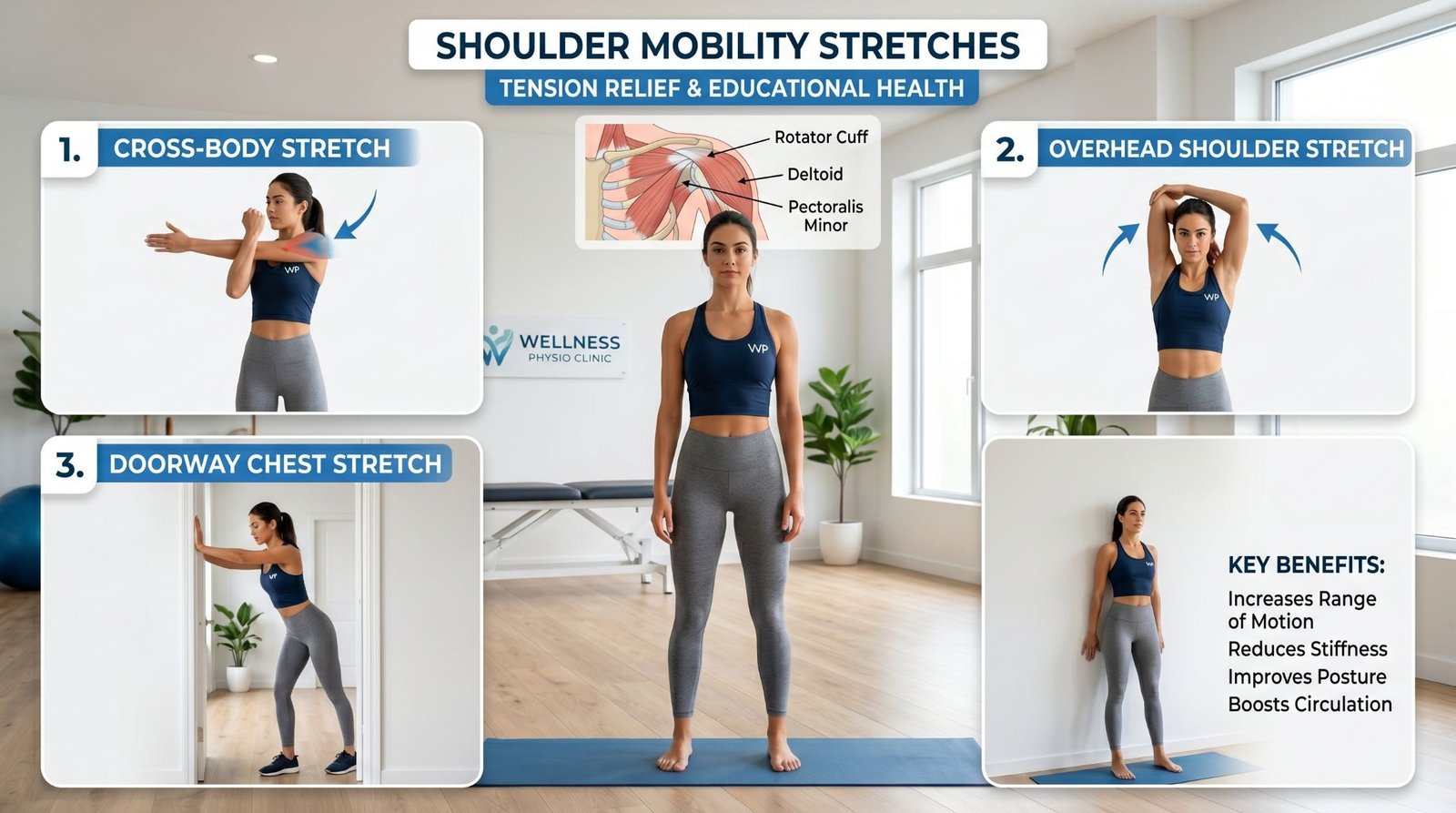

A complete guide from quick daily stretches to a full rotator cuff conditioning program to free your shoulders and stay pain free for life.
Tight aching shoulders can quietly sabotage your entire day from poor posture at your desk to restless sleep at night.
The good news: the right shoulder stretches done consistently can reverse stiffness, reduce pain and restore full range of motion often within just a few weeks.
Why Your Shoulders Get Tight?
Your shoulder is the most mobile joint in the body making it highly vulnerable. Daily habits like hunching over a phone, sitting for long hours or sleeping on one side create muscular imbalances that gradually pull the joint out of alignment.
Over time muscles like the deltoids trapezius rotator cuff group and rhomboids shorten and stiffen due to constant compensation.
Stress increases this problem. When you are anxious or fatigued you naturally raise and tense your shoulders keeping the upper trapezius tight for long periods.
Combined with past injuries or age related changes this can turn shoulder tightness into a persistent condition.
The solution is simple but requires consistency: targeted exercises that activate all major muscles responsible for shoulder mobility.
11 Daily Shoulder Stretches
These stretches require no equipment and can be done at home at your desk or before and after a workout. Aim to complete them as a sequence once daily the whole routine takes about 10 minutes.
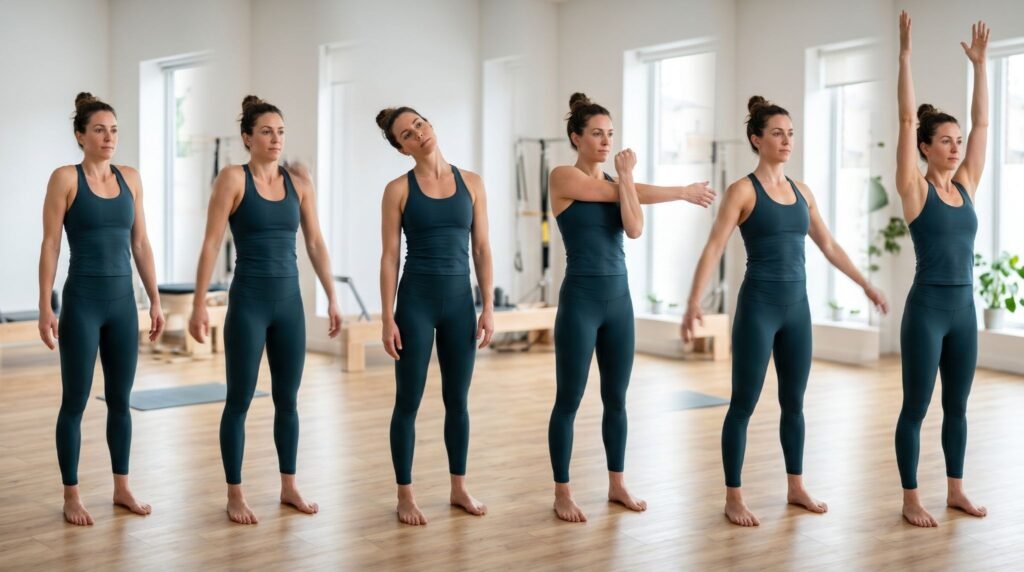
1. Shoulder Raises
A simple but effective move to release upper trapezius tension the muscle most responsible for that “shoulders up to your ears” feeling caused by stress.
• Stand or sit tall with your arms hanging naturally at your sides.
• Slowly shrug both shoulders upward toward your ears.
• Hold at the top for 3-5 seconds squeezing gently.
• Release and drop your shoulders completely feeling the tension melt away.
• Repeat 5 times focusing on the contrast between tension and release.
Pro Tip: Exhale as you lower your shoulders to deepen relaxation of the trapezius muscle.
2. Shoulder Rolls
Shoulder rolls warm up the entire shoulder girdle, lubricate the joint with synovial fluid and are a perfect entry point to any stretching routine.
• Stand or sit with a tall spine.
• Roll both shoulders backward in a smooth large circle up back and down 10 times.
• Then reverse direction up forward and down 10 times.
• Move slowly and deliberately feeling each part of the rotation.
3. Ear to Shoulder Stretch
This targets the lateral neck muscles and upper trapezius one of the primary sites of tension headaches and shoulder stiffness.
• Sit upright and drop your right ear slowly toward your right shoulder.
• Go only as far as is comfortable do not force it or raise the opposite shoulder.
• For a deeper stretch gently rest your right hand on the left side of your head and allow gravity to increase the stretch.
• Hold for 30 seconds. Return to center slowly.
• Repeat on the left side.
Caution: Never pull forcefully on your head. The hand should add gentle weight only not active force.
4. Cross Arm Stretch
One of the most effective posterior deltoid and shoulder capsule stretches. It counteracts the internal rotation caused by desk posture.
• Bring your left arm straight across your chest at shoulder height.
• Use your right arm to support it either hooking the elbow crease around your left arm or holding at the upper arm. Do not pull at the wrist.
• Keep your left shoulder relaxed and pressed down.
• Hold for 30 seconds breathing steadily.
• Switch sides and repeat.
5. Standing Arm Swings
Dynamic arm swings actively increase blood flow warm the joint through its full range and gently mobilize the shoulder capsule before more intense activity.
• Stand with feet shoulder width apart arms relaxed at your sides palms facing inward.
• Swing both arms simultaneously forward and upward as high as they comfortably go without raising your shoulders.
• Allow them to swing back behind your body on the return.
• Keep your torso stable throughout only your arms should move.
• Continue for 1 minute at a relaxed rhythmic pace.
6. Standing Arm Lifts
This gentle overhead movement improves range of motion in the shoulder joint and coordinates shoulder and scapular movement patterns.
• Make soft fists and hold them in front of your hips
• Inhale and raise both arms overhead until hands meet above your head
• Exhale and slowly lower back to starting position
• Perform 10 slow controlled repetitions
7. Wide Legged Standing Forward Bend
A yoga based stretch that opens the chest stretches the shoulder girdle and decompresses the upper spine.
• Stand with feet wider than hip width toes forward
• Interlace fingers behind your back and open your chest upward
• Keep a slight bend in knees and engage leg muscles
• Hinge forward at hips lifting arms slightly away from back
• Let head hang and gently tuck chin toward chest
• Hold for up to 30 seconds while breathing deeply
Modification:
• If you cannot interlace fingers hold a towel between hands behind your back
8. Cat Cow Pose
A flowing movement that mobilizes the spine and activates shoulder and scapular control.
• Start on all fours (wrists under shoulders knees under hips)
• Inhale: drop belly lift chest and tailbone (Cow) and gently squeeze shoulder blades
• Exhale: round spine tuck chin press hands into floor (Cat) and spread shoulder blades
• Flow smoothly between both positions for 2–3 minutes matching breath
9. Thread the Needle
A deep rotational shoulder stretch that releases the posterior capsule and upper thoracic spine.
• Start on all fours with a neutral spine
• Slide your right arm under your body to the left (palm facing up)
• Let your right shoulder and temple rest on the mat
• Left arm stays extended for support or reach upward for deeper stretch
• Avoid collapsing onto the shoulder—keep light muscular engagement
• Hold for 30 seconds then slowly return
• Repeat on the left side
10. Reverse Prayer Pose
A strong chest and shoulder opener targeting pectorals front deltoids and wrist flexors.
• Stand or sit upright with good posture
• Place both hands behind your back (backs of hands touching fingers down)
• Rotate hands so fingers point upward
• Try pressing palms together (or keep backs of hands together if needed)
• Draw elbows slightly back and open the chest
• Hold for 30 seconds with a straight spine
Easier Variation:
• If palms cannot connect hold opposite elbows behind your back instead.
11. Cow Face Pose (Arms)
This yoga classic targets opposite aspects of the shoulder simultaneously one arm stretches the external rotators while the other opens the internal rotators. A complete bilateral stretch in one position.
• Sit comfortably on the floor or chair
• Lift left arm bend elbow and let hand drop down your back
• Use right hand to gently guide left elbow inward
• If possible bring right arm behind back and try to clasp both hands
• Use a strap or towel if hands don’t reach
• Hold for 1 minute with steady breathing
• Switch arms and repeat
Rotator Cuff Conditioning Program
If your goal is not just flexibility but genuine shoulder stability and injury prevention the following three exercises from the American Shoulder and Elbow Surgeons are essential.
These target the deep rotator cuff muscles that hold your joint together. Perform these 3 days per week. Warm up with 5-10 minutes of light walking beforehand. Do not exercise through pain.
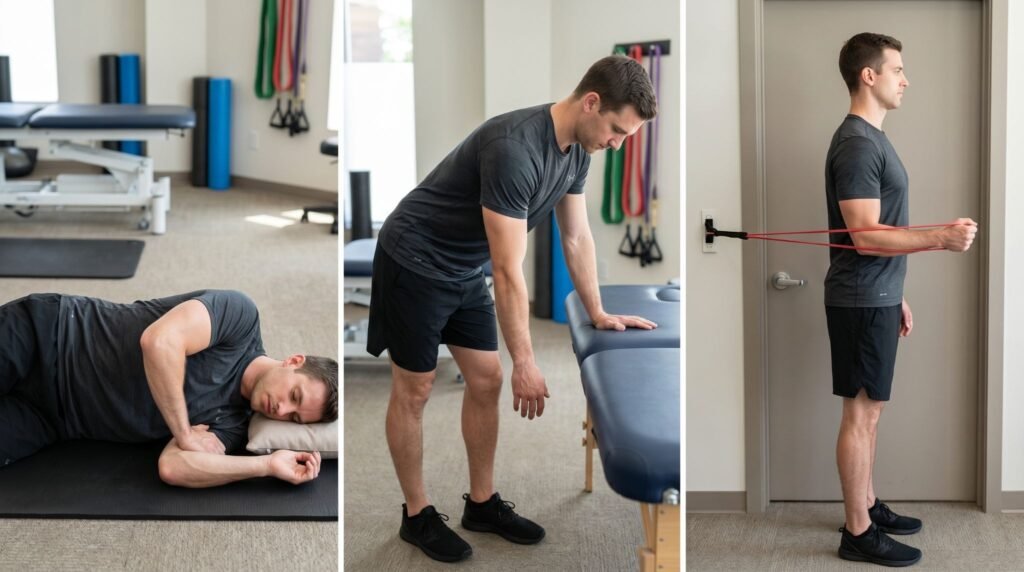
12 Sleeper Stretch
Muscles: Infraspinatus | Teres minor | Posterior capsule
• Lie on your side with the affected shoulder underneath you
• Keep your arm bent at 90 degrees
• Use your upper arm to gently press your lower forearm toward the bed
• Continue until you feel a deep stretch in the back of the shoulder
• Hold for 30 seconds
• Relax for 30 seconds
• Repeat 4 times
• Perform daily
• Do not press on the wrist only press the forearm
13 Pendulum Swing
Muscles: Deltoids | Supraspinatus | Subscapularis
• Lean forward and support yourself with one hand on a table or chair
• Let the other arm hang freely
• Gently swing the arm forward and backward
• Then swing side to side
• Then make small circular motions
• Use momentum not muscle force
• Complete 2 sets of 10 in each direction
• Perform 5–6 days per week
Note: The pendulum is often the first exercise prescribed after shoulder surgery its gentle traction decompresses the joint naturally.
14 External Rotation with Resistance Band
Muscles: Infraspinatus | Teres minor | Posterior deltoid
• Attach a resistance band to a door handle at waist height
• Stand sideways to the door
• Hold the band with the hand farthest from the door
• Keep elbow bent at 90 degrees
• Press elbow firmly against your side
• Slowly rotate forearm outward away from the body
• Stop when arm aligns with torso
• Return slowly (5 second controlled movement)
• Perform 3 sets of 8–12 reps
• Do 3 days per week
Key Benefits of Regular Shoulder Stretching
Increased Range of Motion
Consistent stretching lengthens shortened muscles and loosens the shoulder capsule helping you reach further with less restriction.
Reduced Pain & Stiffness
A 2016 study of office workers found that regular neck and shoulder stretches over four weeks significantly reduced pain scores.
Injury Prevention
Flexible well activated shoulder muscles are better equipped to absorb impact and resist overuse injuries.
Stress Relief
Releasing physical tension in the shoulders has a measurable effect on overall feelings of calm and mental well being.
Better Athletic Performance
Optimal shoulder mobility unlocks better technique in swimming weightlifting racket sports and more.
Improved Posture
Open mobile shoulders naturally encourage an upright spine reducing forward rounded posture and chronic neck pain.
Common Causes of Tight Shoulders
Understanding what causes shoulder tightness helps you not only treat it but prevent it from coming back.
• Extended sitting or desk work
• Prolonged phone or screen use
• Sleeping on one side repeatedly
• Carrying heavy bags on one shoulder
• Chronic psychological stress
• Muscle weakness or imbalance
• Poor posture and spinal alignment
• Overuse from sport or repetitive work
• Previous shoulder injury or surgery
• Underlying conditions (arthritis bursitis)
In some cases persistent shoulder tightness may indicate a medical condition such as arthritis gout lupus or Lyme disease. If symptoms do not improve within 2–3 weeks of stretching and lifestyle changes it is important to consult a doctor.
Prevention: Keeping Your Shoulders Healthy Long Term
• Stretch your shoulders daily even a 5 minute routine makes a meaningful difference over time. Take movement breaks every 30 minutes when working at a desk (stand walk roll shoulders).
• Strengthen shoulder support muscles (rotator cuff mid trapezius) at least twice weekly.
• Stay well hydrated to keep muscles and connective tissue flexible and aid recovery.
• Manage stress as chronic stress increases upper shoulder (trapezius) tension.
• Switch shoulders when carrying bags or use a backpack to distribute weight evenly.
• Swimming and yoga are excellent preventive activities—continue them if you already do them.
• Consider monthly massage therapy to reduce tension buildup and prevent injuries early.
When to See a Doctor
Seek medical attention if you experience:
• Sharp or shooting pain during movement or stretching.
• Shoulder pain lasting more than 2–3 weeks without improvement.
• Numbness tingling or weakness radiating down the arm.
• Visible deformity or significant swelling in the joint.
• Pain with fever (possible infection or systemic issue).
• Sudden loss of range of motion especially inability to lift arm above shoulder height.
These symptoms may indicate conditions such as rotator cuff tears labral damage impingement syndrome thoracic outlet syndrome or cervical spine issues—all requiring professional diagnosis before starting any exercise program.
FAQs
How often should I do shoulder stretches?
Daily stretching is ideal for most people. Even a 5–10 minute routine can improve flexibility and reduce pain within 2–4 weeks. If shoulders are very tight or you’re recovering from injury doing gentle stretches twice daily may speed up recovery.
Can shoulder stretches fix a rotator cuff injury?
Mild strains may improve with stretching and strengthening but partial or full tears need medical evaluation. Stretching cannot repair torn tissue but a proper conditioning program can reduce pain and prevent further damage during recovery.
Should I stretch before or after exercise?
Use dynamic stretches (like arm swings and shoulder rolls) before exercise to warm up the joint. Do static stretches (like cross arm stretch or thread the needle) after exercise when muscles are warm. Always warm up for at least 5 minutes before stretching.
Why do my shoulders feel tight even though I stretch regularly?
Persistent tightness usually comes from muscle imbalance—tight chest and internal rotators overpower weaker upper back muscles. Strengthening the mid trapezius rhomboids and rotator cuff is essential. Poor posture and stress can also quickly reverse flexibility gains.
Are there stretches I can do at my desk?
Yes. Shoulder rolls shoulder raises ear to shoulder stretch cross arm stretch and arm swings can all be done at your desk. Even 2 minutes of movement every 30 minutes can significantly reduce stiffness during long sitting hours.


 By
By


 By
By