
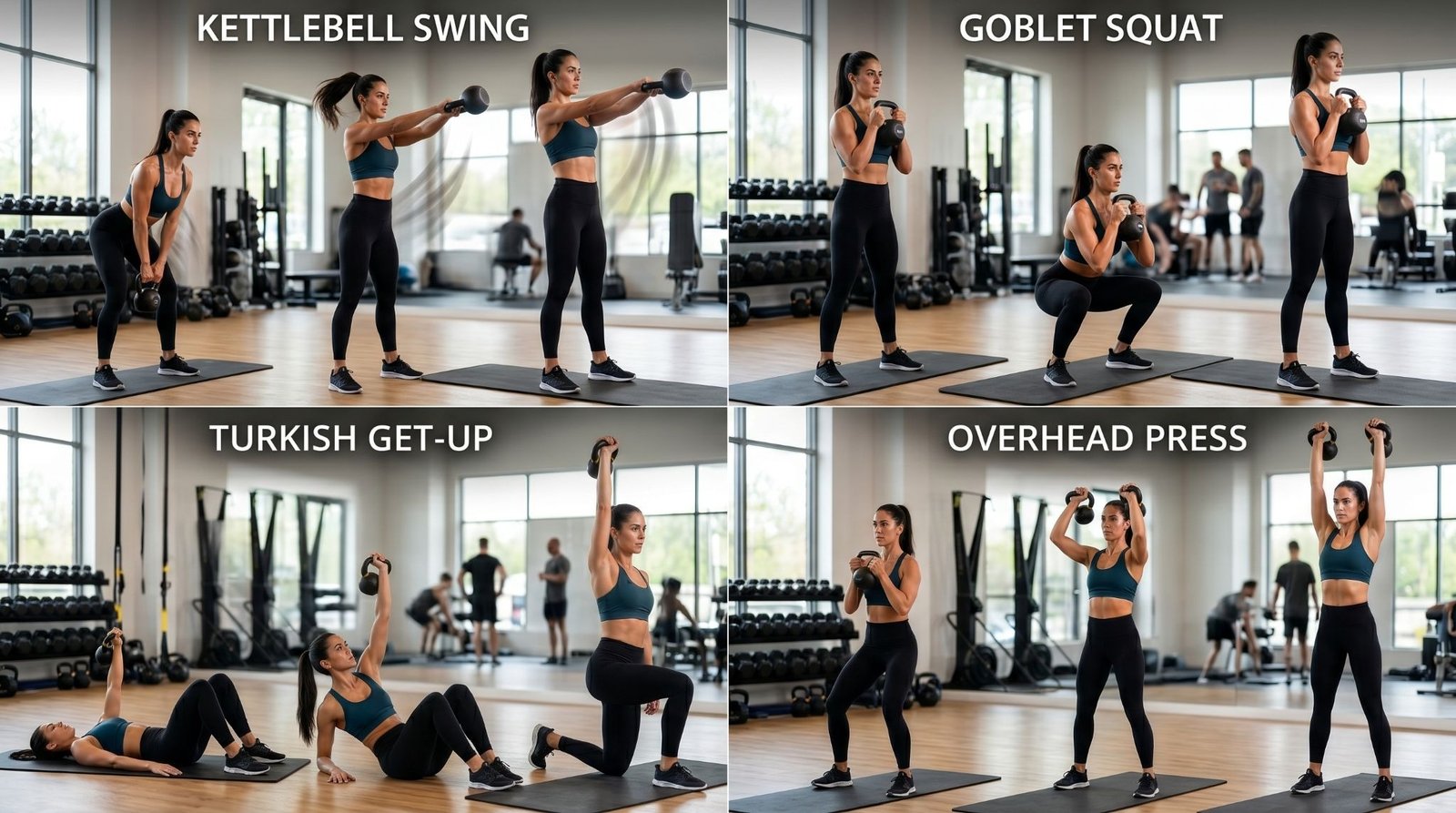

The best kettlebell exercises are the swing goblet squat Turkish get-up clean and press snatch deadlift renegade row farmer’s carry windmill sumo high pull single arm shoulder press and kettlebell lunge.
Together these 12 movements cover every major muscle group posterior chain core upper body and lower body making kettlebells one of the most efficient training tools you can pick up. Whether your goal is fat loss, strength or conditioning these exercises deliver.
Why Kettlebells Work Better Than You Think?
The kettlebell’s offset center of gravity forces constant stabilizer engagement unlike a balanced dumbbell it pulls against you every rep. You’ll notice this immediately during Turkish get-ups when your core works harder than most dedicated ab workouts.
Research backs this up: studies show kettlebell training improves strength, aerobic capacity and balance simultaneously while snatches burn roughly 20 calories per minute comparable to a 6-minute mile pace. That’s cardio and strength training combined.
Best of all a single 16kg kettlebell plus bodyweight is all you need for a complete program no machines bench or rack required.
Choosing the Right Kettlebell Weight (Before You Lift Anything)
Starting too heavy is the fastest route to a lower back injury. Starting too light means you won’t see results.
The American Council on Exercise recommends these starting ranges:
| Experience Level | Women | Men |
| Beginner | 8–15 lbs (4–7 kg) | 15–25 lbs (7–11 kg) |
| Intermediate/Advanced | 18 lbs+ (8 kg+) | 35 lbs+ (16 kg) |
One caveat: these numbers shift depending on the exercise. The goblet squat allows heavier loads than the Turkish get-up. The swing uses more weight than the windmill. Match the weight to the movement, not just your general fitness level.
12 Best Kettlebell Exercises
1. Kettlebell Swing
Muscles: Glutes hamstrings core shoulders | Reps: 15–20 or 20s on / 30s off
How to do it:
- Feet shoulder-width apart bell on the floor in front
- Hinge at hips (not knees) and grab the handle
- Pull bell back between your legs
- Drive hips forward explosively let momentum float it to shoulder height
- Squeeze glutes at top hinge back down with neutral spine
- This is a hip hinge not a squat high-rep sets also work as conditioning
2. Goblet Squat
Muscles: Quads hamstrings glutes core | Reps: 8–12
How to do it:
- Hold bell by the horns at chest height
- Feet slightly wider than shoulder-width toes 15–30° out
- Sit down into the squat
- Keep elbows inside knees at the bottom
- Front-loaded weight keeps torso upright and opens hips naturally
3. Turkish Get-Up
Muscles: Core shoulders glutes hip stabilizers | Reps: 3–5 each side
How to do it:
- Lie flat bell pressed above right shoulder right knee bent
- Roll to elbow → press to hand → lift hips
- Sweep leg through to kneeling → stand up
- Reverse the full sequence back to the floor
- Keep eyes on the bell throughout
- Learn with a shoe on your fist before adding weight
4. Clean and Press
Muscles: Glutes back shoulders triceps core | Reps: 5–8 each side
How to do it:
- Hip-driven pull brings the bell into rack position at shoulder
- Elbow tucked wrist straight bell resting on forearm
- Press overhead until arm fully extended bicep near ear
- Lower slowly and with control
- Bruised forearm = bell swinging too wide
5. Kettlebell Deadlift
Muscles: Glutes hamstrings lower back lats grip | Reps: 6–8
How to do it:
- Place bell between feet handle at ankle level
- Hinge at hips and grip the handle
- Lift by pushing the floor away
- Easier on the lower back than a barbell deadlift
- Great foundation before progressing to swings
6. Kettlebell Snatch
Muscles: Posterior chain shoulders core | Reps: 5–10 each side
How to do it:
- Start like a swing then pull the bell close to your body
- Punch your hand through overhead in one smooth motion
- Finish with arm fully locked out above shoulder
- Research shows 86–99% max heart rate cardio-level output
- Get 6–8 weeks of swings and cleans in before attempting
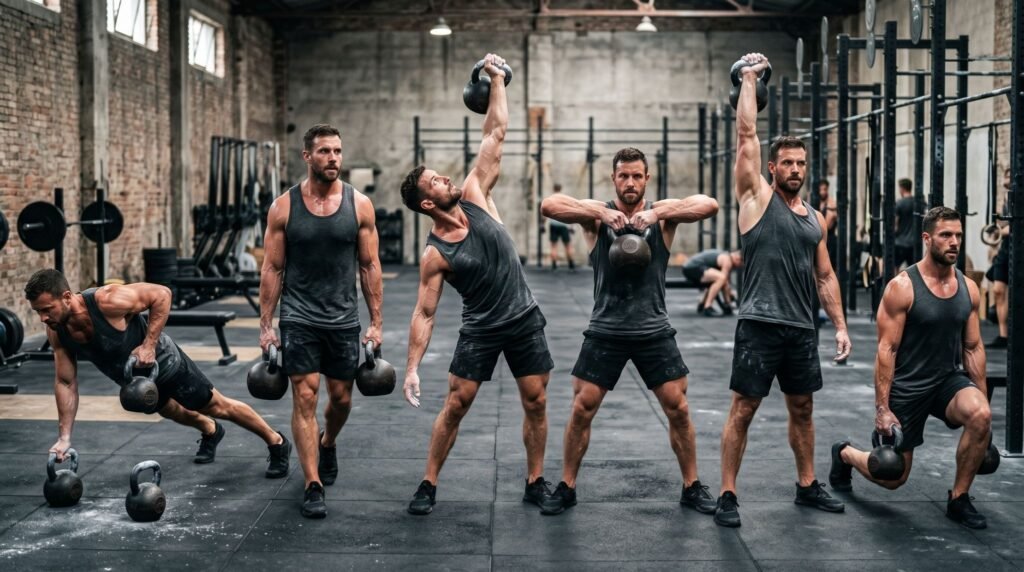
7. Renegade Row
Muscles: Lats biceps core triceps | Reps: 6–8 each side
How to do it:
- Get into push-up position hands gripping two bells
- Row one bell to your ribcage while the other arm supports you
- Keep hips from rotating that’s where the real benefit is
- Feet wide for stability glutes squeezed throughout
- Obliques work harder here than in most dedicated core exercises
8. Farmer’s Carry
Muscles: Grip traps obliques spinal erectors glutes | Reps: 20–40m per set
How to do it:
- Pick up two heavy bells and walk that’s it
- Stand tall shoulders back core braced
- Every step forces obliques and spinal erectors to work
- Single-arm (suitcase carry) reveals core imbalances quickly
- Trains grip strength a reliable predictor of overall health
9. Kettlebell Windmill
Muscles: Obliques hamstrings glutes shoulder stabilizers | Reps: 5–8 each side
How to do it:
- Press bell overhead in right hand
- Turn feet 45° to the left
- Hinge at hip and slide left hand down left leg
- Keep right arm extended and eyes on the bell the whole time
- Go slow range of motion matters more than weight
10. Sumo High Pull
Muscles: Glutes hamstrings traps shoulders core | Reps: 8–10
How to do it:
- Stand wide toes out bell between feet
- Hinge down and grip the handle
- Explosively extend hips then pull bell to chin height
- Elbows flare wide at the top
- Great for upper back and trap activation especially for overhead athletes
11. Kettlebell Shoulder Press
Muscles: Deltoids triceps upper traps core | Reps: 6–8 each side
How to do it:
- Start from rack position at shoulder
- Press overhead until arm fully extended
- Lower slowly and with control
- Keep core braced don’t arch lower back as weight increases
- Studies show greater muscle activation than dumbbell press due to offset load
12. Kettlebell Lunge
Muscles: Quads glutes hamstrings core | Reps: 8 each leg
How to do it:
- Hold one or two bells at your sides
- Step forward and lower back knee toward the floor
- Drive through front heel to return to standing
- Alternate legs or finish one side at a time
- Add an overhead press at the top for a full-body conditioning combo
A Simple Weekly Structure
You don’t need 12 exercises in every session. Here’s a practical starting framework:
Session A Strength focus:
Deadlift 3×8 → Goblet Squat 3×10 → Clean and Press 3×6 each side → Farmer’s Carry 3×30m
Session B Conditioning focus:
Kettlebell Swing 5×20 → Renegade Row 3×8 each side → Shoulder Press 3×8 each side → Turkish Get-Up 3×3 each side
Train 2–3 times per week. Rest at least one day between sessions. Progress by adding reps before weight.
Benefits Beyond the Obvious
Kettlebell circuits boost cardiovascular fitness research cited by the NSCA’s TSAC Report shows ~6% VO2 max improvement in under a month of three-weekly training.
For older adults they restore muscle mass and grip strength countering sarcopenia with swings and farmer’s carries being especially effective for functional strength.
Unlike machines and cables kettlebells improve balance and posture through unilateral loading forcing stabilizer muscles to adapt. Over time this means better posture, less lower back discomfort and improved athletic performance.
Safety and Common Mistakes
The most common kettlebell injury is lower back strain during the swing caused by squatting instead of hinging or letting the back round at the bottom. Always warm up 5–10 minutes with hip circles, bodyweight squats and shoulder rotations.
Key rules: never round your lower back during hinges; maintain a firm grip on cleans; stop immediately if you feel sharp pain (fatigue is normal sharp pain is not); wear flat-soled shoes for stability.
If returning from injury or managing conditions like osteoporosis or rotator cuff issues consult a physiotherapist first modifications exist but they matter.
Key Takeaway
Kettlebells reward commitment to technique over the pursuit of heavier weights. Master the swing and the goblet squat first; everything else builds from those two movement patterns.
Add one or two new exercises each month rather than attempting all 12 at once. The athletes and lifters who get the most out of kettlebell training are the ones who take the fundamentals seriously for longer than feels necessary.
One kettlebell consistent practice and the 12 exercises above that’s a complete training program.
FAQs
How heavy should a kettlebell be for a beginner?
ACE recommends 8–15 lbs (4–7 kg) for women and 15–25 lbs (7–11 kg) for men with no prior training. Weight varies by exercise; goblet squats handle more than Turkish get-ups.
Are kettlebell swings good for weight loss?
Yes. They’re highly calorie-efficient burning ~20 calories/min in high-intensity intervals. With a calorie deficit and protein intake they support fat loss especially in the posterior chain and core.
Can kettlebell exercises replace cardio?
For general fitness yes. Kettlebell circuits improve heart rate and VO2 max similar to moderate cardio. For endurance sports dedicated cardio is still needed.
How often should you do kettlebell workouts?
2–3 times per week with rest days between is ideal. Beginners start at 2x weekly; advanced users may train more often by varying exercises.
What muscles do kettlebell exercises work most?
Mainly the posterior chain (glutes hamstrings lower back). The core is engaged in nearly all movements. Shoulders and upper back are heavily used in pressing and carries.

 By
By

 By
By