

FaceTite is a minimally invasive cosmetic procedure that uses radiofrequency assisted lipolysis (RFAL) to tighten loose skin and remove small fat deposits on the lower face jawline and neck.
It is FDA approved, takes 60 to 120 minutes and costs between $3700 and $9300 in the United States with a national average near $4850.
Results last three to five years. The procedure suits adults with mild to moderate sagging who want a non surgical alternative to a facelift but it is not a substitute for one when sagging is severe.
This guide explains what FaceTite actually does, who should not get it the real recovery timeline and how to vet a provider before you commit thousands of dollars.
How FaceTite Works?
FaceTite uses a two part probe. A thin internal electrode is inserted under the skin through a small incision while an external sensor sits on the skin surface.
The probe delivers controlled radiofrequency energy that heats the fat layer and the underside of the skin simultaneously.
Two things happen at once. The heat melts targeted fat which is then removed through a thin liposuction cannula. T
he same heat triggers the body’s wound healing response stimulating new collagen and elastin production over the following weeks.
That collagen remodeling is what produces the gradual tightening seen at three to six months.
The external sensor controls the heat to prevent burns. This safety mechanism is what separates FaceTite from older RF lipolysis devices that carried a higher complication rate.
Who FaceTite Is For and Who It Isn’t
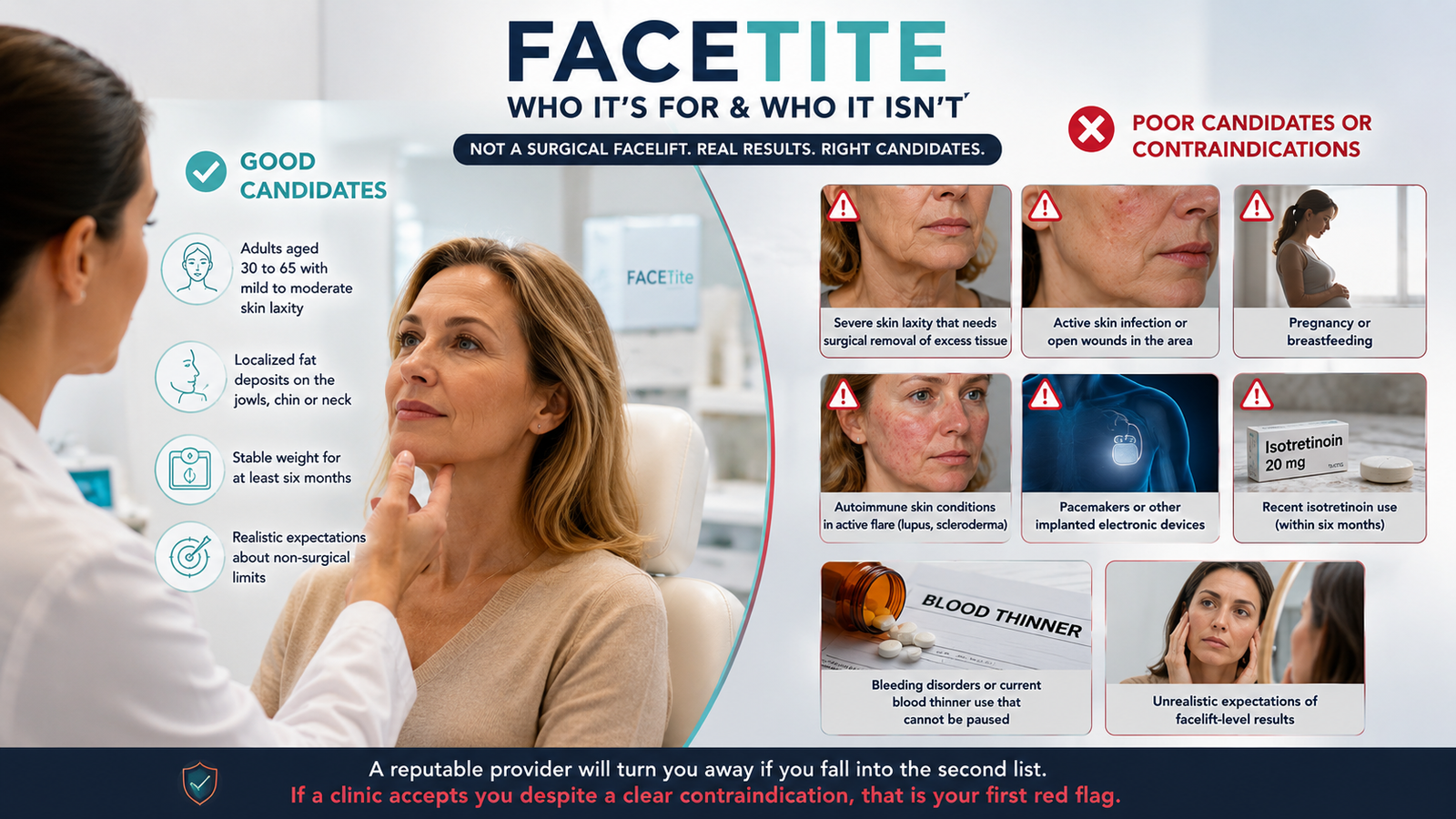
This is where most online guides fail readers. FaceTite is not appropriate for everyone with sagging skin.
Good candidates:
- Adults aged 30 to 65 with mild to moderate skin laxity
- Localized fat deposits on the jowls chin or neck
- Stable weight for at least six months
- Realistic expectations about non surgical limits
Poor candidates or contraindications:
- Severe skin laxity that needs surgical removal of excess tissue
- Active skin infection or open wounds in the treatment area
- Pregnancy or breastfeeding
- Autoimmune skin conditions in active flare (lupus scleroderma)
- Pacemakers or other implanted electronic devices
- Recent isotretinoin use (within six months)
- Bleeding disorders or current blood thinner use that cannot be paused
- Unrealistic expectations of facelift level results
A reputable provider will turn you away if you fall into the second list. If a clinic accepts you despite a clear contraindication that is your first red flag.
FaceTite Procedure: What Actually Happens
The full procedure takes 60 to 120 minutes depending on how many areas are treated. Patients usually go home the same day.
- Consultation and assessment. Your provider examines the treatment areas discusses goals and confirms candidacy. Photos are taken for before and after comparison
- Skin marking. The areas to be treated are mapped with a surgical pen while you are seated upright so the markings reflect how your face actually looks under gravity
- Anesthesia. Local anesthetic is injected into the treatment zones. Some clinics offer oral sedation for anxiety but general anesthesia is not used
- Incisions. Tiny incisions typically 2 to 3 millimeters are made in concealed locations such as under the chin or behind the ear
- Energy delivery. The internal probe is inserted and moved methodically under the skin while delivering radiofrequency energy. The external sensor monitors surface temperature throughout
- Fat removal. Liquefied fat is suctioned out through the same incision points
- Closure and dressing. Most incisions require a single suture or are closed with adhesive strips. A compression garment is fitted before you leave
Most patients describe the sensation as a warm pressure with occasional sharper pulses where the probe passes near nerves. It is uncomfortable but not severe. Anyone telling you it is painless is overselling.
FaceTite Cost in 2026
The national average cost in the United States is $4848 with a typical range of $3725 to $9265. Cost varies based on treatment area provider experience geography and whether additional procedures are combined.
| Treatment area | Typical cost range |
| Lower face only (jowls jawline) | $3500 to $5500 |
| Neck only | $3000 to $5000 |
| Lower face plus neck | $5500 to $9500 |
| Full face plus neck (with AccuTite for eyes) | $7000 to $12000 |
Insurance does not cover FaceTite because it is cosmetic. Many providers offer financing through CareCredit Cherry or in house plans.
Promotional pricing during slow months (typically January and August) can shave 10 to 20 percent off list prices. A note on price shopping.
Quotes far below the regional average usually mean one of three things: an inexperienced injector a different device being substituted (often a generic RF tightening tool) or hidden fees added later.
Cheap is rarely a bargain in this category.
Recovery: The Honest Timeline
Marketing copy compresses recovery into “a few days.” The reality is more layered.
- Day 1: Significant swelling and tightness. Compression garment worn 23 hours a day. Sleeping with head elevated is necessary
- Days 2 3: Bruising peaks. Numbness or tingling is normal. Most people stay home
- Days 4 7: Bruising fades. Many return to work though visible swelling may still be apparent. Compression garment continues at night
- Weeks 2 3: Most external swelling resolved. Skin may feel tight or “buzzy.” Strenuous exercise still restricted
- Month 1: Subtle tightening visible. Numbness in some areas may persist
- Months 3 6: The collagen remodeling becomes obvious. Final contour emerges
- Up to 12 months: Continued gradual tightening as collagen matures
[INTERNAL LINK: Recovery Guide: What to Expect After FaceTite]
Call your provider immediately if you experience persistent bleeding fever expanding redness severe asymmetric swelling after week one or loss of sensation that does not improve over several weeks.
What 40% Tightening Really Looks Like?
The number “40 percent tightening compared to a surgical facelift” gets repeated across every FaceTite article without explanation. Here is what it actually means.
If a full surgical facelift would tighten your jawline by 1 centimeter of redraped tissue FaceTite gives you about 4 millimeters of tightening.
On a person with mild jowling that is enough to noticeably sharpen the jawline and reduce a soft chin. On a person with significant excess skin 4 millimeters does not solve the problem.
This is why expectations matter. FaceTite is excellent for mild to moderate cases. It is the wrong tool for someone who genuinely needs a facelift.
A good provider will tell you this and refer you elsewhere if needed. A bad one will book you anyway and disappoint you six months later.
FaceTite vs Other Procedures
| Procedure | Best for | Invasiveness | Downtime | Cost range | Results last |
| FaceTite | Mild to moderate sagging plus small fat deposits | Minimally invasive (incisions) | 5 7 days | $3700 $9300 | 3 5 years |
| Surgical facelift | Significant sagging deep folds | Surgical | 2 3 weeks | $7000 $15000+ | 10+ years |
| Ultherapy | Mild laxity no fat concerns | Non invasive (no incisions) | 0 days | $1500 $5000 | 1 2 years |
| Morpheus8 | Skin texture fine wrinkles mild laxity | Minimally invasive (microneedling) | 2 4 days | $1500 $4000 per session | 1 2 years |
| Thread lift | Mild jowl repositioning | Minimally invasive | 3 5 days | $1500 $4500 | 1 2 years |
FaceTite and Morpheus8 are made by the same company (InMode) and are often combined in a single appointment.
The combination treats both deep tissue laxity (FaceTite) and surface texture (Morpheus8) at once which is why many providers package them together as a “non surgical facelift.”
How to Choose a Qualified Provider?
This is the variable that affects results most and most online guides treat it as an afterthought.
Verify board certification
Look for a plastic surgeon facial plastic surgeon or dermatologist certified by the American Board of Plastic Surgery ABFPRS or American Board of Dermatology
Confirm device authenticity
Ask whether they use the actual InMode FaceTite handpiece. Some clinics advertise FaceTite but substitute generic RF devices that produce weaker results
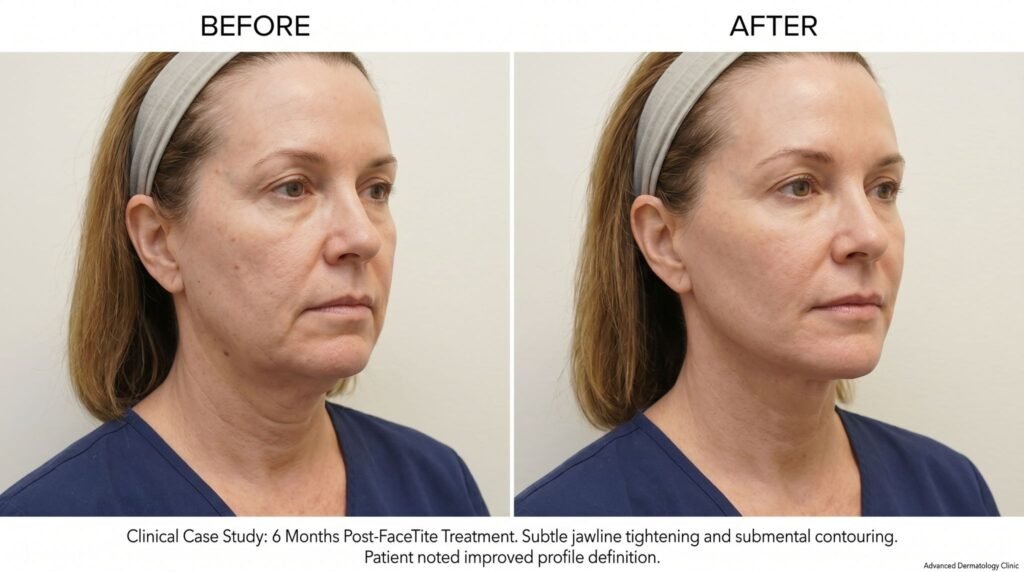
Demand before and after photos of their own patients
Stock photos and manufacturer images are red flags. The provider should show you their work ideally on faces similar to yours
Ask how many FaceTite procedures they perform monthly
Fewer than 5 to 10 is a sign of limited experience
Discuss complications openly
A skilled provider will describe the failure modes without flinching. A nervous provider may oversell safety
Compare two consultations minimum
The most expensive quote is not always the best and the cheapest almost never is
Read reviews on multiple platforms
RealSelf Google and the provider’s own site each filter feedback differently. Triangulate
A consultation should never feel like a sales pitch. Walk away from any clinic pressuring you to book on the day you visit.
FAQs
Is FaceTite painful?
Most patients feel warm pressure with occasional sharp pulses. Local anesthesia minimizes pain. Mild soreness, tightness and numbness can last 1–2 weeks and usually only require acetaminophen.
How long do results last?
Typically 3–5 years longer with good skincare and stable weight. Aging continues so results soften over time. Many opt for a touch up after ~5 years.
FaceTite vs Morpheus8?
FaceTite targets deep tissue and fat using RF under the skin. Morpheus8 uses microneedles to improve surface texture and fine wrinkles. They treat different concerns and are often combined.
When can I return to work?
Most return in 3–5 days. Visible swelling/bruising may last longer; client facing roles may need about a week.
Can it replace a facelift?
Yes for mild–moderate laxity. No for severe sagging. Facelifts remove excess skin; FaceTite tightens existing tissue and small fat deposits.


 By
By

 By
By