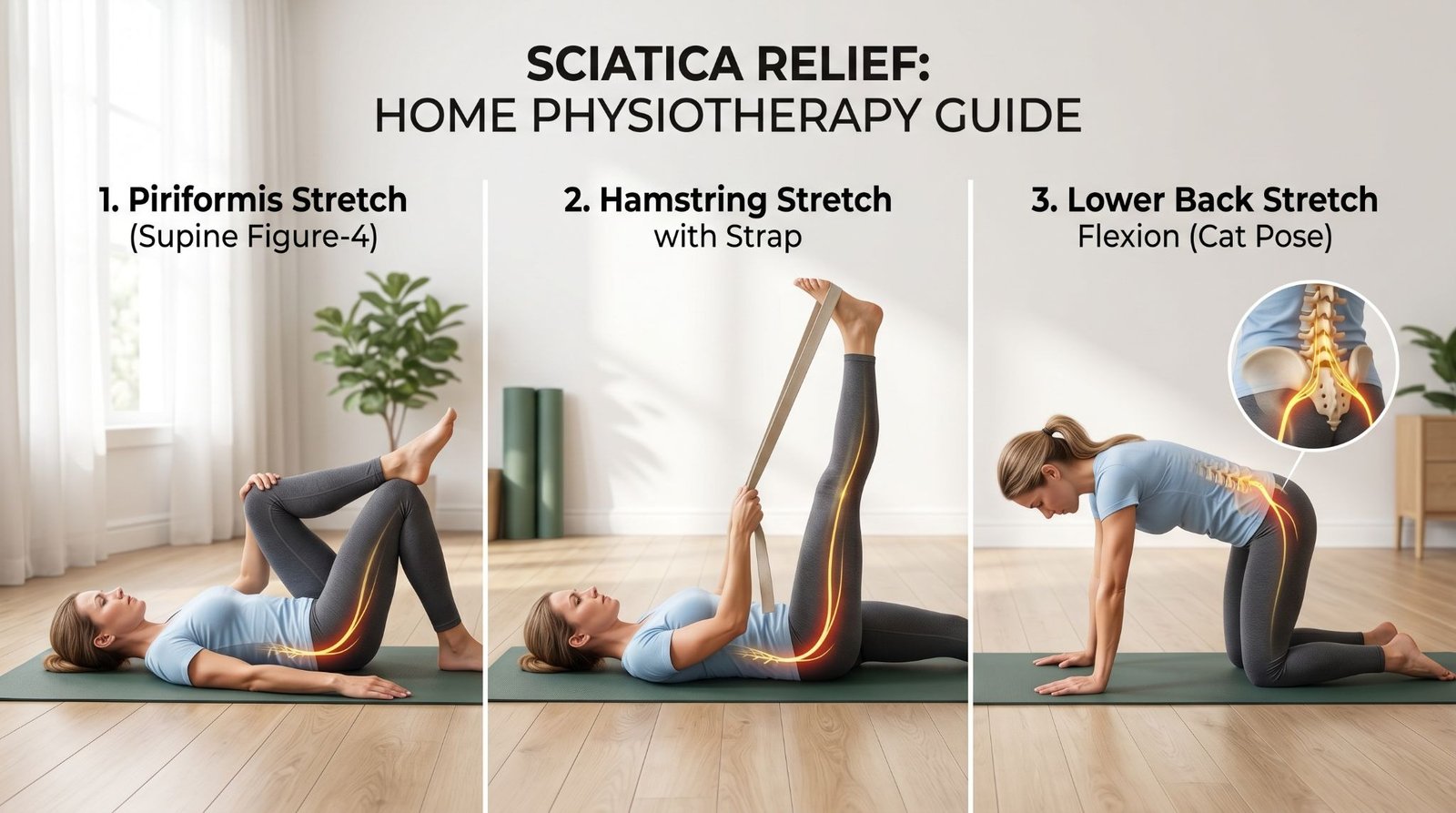

Sciatica stretches work by reducing pressure on the sciatic nerve which runs from your lower back through your buttock and down each leg. The most effective moves target three areas: the piriformis muscle, the hamstrings and the lumbar spine.
Done consistently stretching can ease sciatic nerve pain within days though the right stretch depends on the cause of your pain. Here are 9 clinically supported movements plus exactly how long each one to hold.
Why Do These Stretches Relieve Sciatic Nerve Pain?
The sciatic nerve is the longest nerve in the body. When compressed or irritated by a herniated disc, tight piriformis muscle or spinal inflammation the pain follows its path from the lower back through the hip down the thigh and sometimes to the foot.
Stretching helps in two key ways. First it lengthens surrounding muscles like the piriformis and hamstrings creating more space and reducing nerve compression.
Second movement improves circulation and lowers inflammatory chemicals that increase nerve sensitivity. Research shows people who stay active recover faster than those who remain inactive.
As physical therapist Mindy Marantz explains the first step is identifying restricted movement most commonly in the lower back and hips which is a key factor in many sciatica cases.
Key Takeaway: Sciatica stretches reduce nerve compression and inflammation. Consistency over 5–7 days is more effective than intensity in a single session.
9 Sciatica Stretches Step by Step
Perform each stretch on a firm surface. Move slowly, breathe steadily and stop at the point of mild tension not pain. The goal is gentle elongation not maximum range.
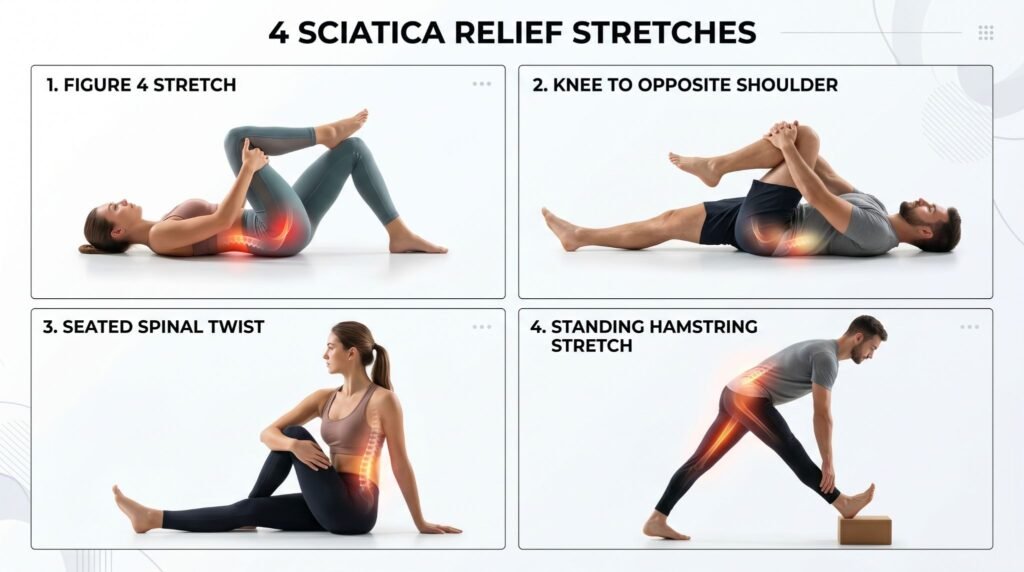
1. Figure 4 Stretch (Piriformis Release)
Best for: buttock and hip pain
This is the single most effective move for piriformis driven sciatica. Crossing one leg creates a lever that passively stretches the deep gluteal muscles pressing on the sciatic nerve.
1. Lie on your back with both knees bent, feet flat on the floor.
2. Cross your right ankle over your left thigh just above the knee.
3. Either hold this position or gently pull your left thigh toward your chest until you feel a deep stretch in the right hip and buttock.
4. Hold for 30 seconds. Repeat 3 times. Switch sides.
Hold time: 30 seconds x 3 reps. Frequency: daily.
2. Knee to Opposite Shoulder
Best for: hip and buttock pain
This stretch pulls the gluteus maximus and piriformis into a diagonal stretch the exact direction needed to decompress the nerve where it exits the piriformis.
1. Lie on your back with legs extended flat.
2. Bend your right knee and clasp both hands around it.
3. Gently draw the knee diagonally across your body toward your left shoulder.
4. Hold for 30 seconds where you feel the stretch not beyond it. 3 reps each side.
3. Seated Spinal Twist
Best for: lumbar compression
Rotation creates space between the lumbar vertebrae which directly reduces pressure on nerve roots exiting the spinal canal. This is particularly useful for disc related sciatica.
1. Sit on the floor with legs extended straight in front of you.
2. Bend your right knee and place the foot flat on the floor outside your left knee.
3. Place your left elbow on the outside of the right knee and gently rotate your torso to the right.
4. Sit tall through the whole movement. Hold 30 seconds x 3 reps each direction.
4. Standing Hamstring Stretch
Best for: leg pain and tightness
The hamstrings attach at the ischial tuberosity via the sacrotuberous ligament. When chronically tight they mimic and worsen sciatica symptoms by pulling on the pelvis and increasing nerve tension down the leg.
1. Stand and place your right heel on a surface at hip height or below such as a step or chair seat.
2. Keep the leg straight. Flex the foot upward toes toward the ceiling.
3. Hinge slightly forward at the hip without rounding your back until you feel a firm pull along the back of the thigh.
4. Hold 30 to 45 seconds. 2 to 3 reps per side.
Note: If you feel nerve like tingling down the leg during this stretch ease off the angle. You may be stretching the nerve itself rather than just the muscle.
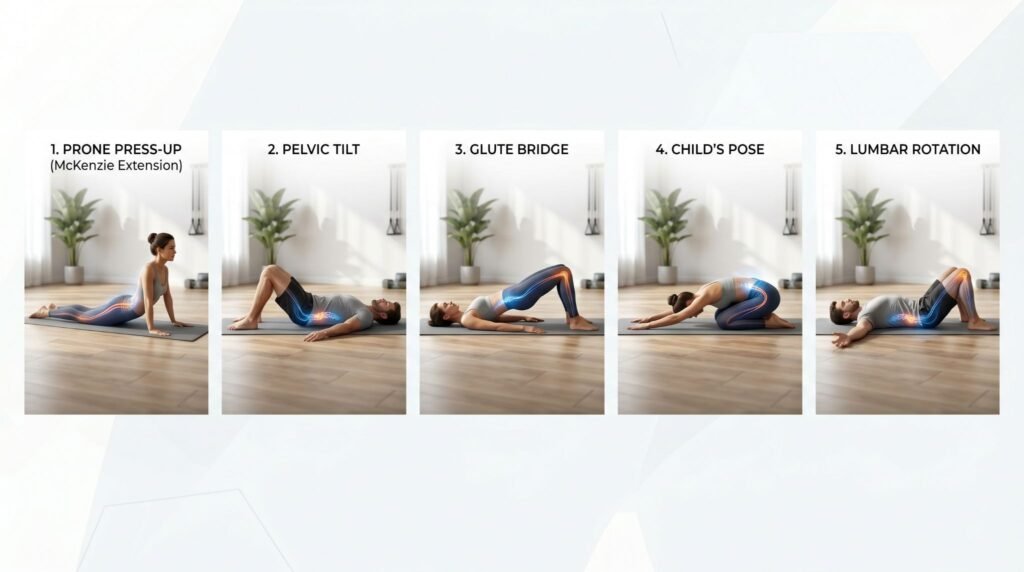
5. Prone Press Up (McKenzie Extension)
Best for: disc related sciatica
Extension movements work specifically for disc herniation sciatica by encouraging the disc material to migrate away from the nerve root.
If your pain travels further down the leg during this move, stop immediately.
1. Lie face down with your hands positioned under your shoulders.
2. Press up slowly, extending the lower back while keeping your hips on the floor.
3. Go only as far as is comfortable. Hold 10 to 15 seconds. Lower with control. 8 to 10 reps.
Research on McKenzie method for lumbar disc herniation represents some of the strongest evidence available in conservative sciatica management.
6. Pelvic Tilt
Best for: lower back stiffness
The pelvic tilt activates deep stabilising muscles around the lumbar spine reducing the micro instability that causes nerve irritation. It is subtle but consistently underrated in self care routines.
1. Lie on your back, knees bent, feet flat on the floor.
2. Tighten your abdominal muscles and press your lower back flat against the floor.
3. Hold for 5 seconds. Release. 10 to 15 reps. Can be done 2 to 3 times daily.
7. Glute Bridge
Best for: building glute strength to protect the nerve long term
A bridge is not just a stretch. It builds the gluteal strength that reduces sciatic nerve compression over time.
Weak glutes force surrounding muscles to overcompensate, tightening the piriformis and deepening the cycle of irritation.
1. Lie on your back knees bent feet hip width apart.
2. Press through your heels and lift your hips until your body forms a straight line from knees to shoulders.
3. Squeeze your glutes at the top. Hold 5 to 10 seconds. Lower slowly. 10 reps.
8. Child’s Pose
Best for: general lumbar decompression
The child’s pose gently tracts the lumbar spine widening the space between vertebrae and reducing pressure on nerve roots. It is one of the few positions that is safe and helpful at virtually any stage of a sciatica episode.
1. Kneel on all fours. Sink your hips back toward your heels.
2. Extend your arms forward or rest them alongside your body.
3. Let your forehead rest on the floor. Breathe deeply and hold for 1 to 3 minutes.
9. Lumbar Rotation
Best for: morning stiffness
This gentle rotation mobilises the facet joints of the lower spine and is particularly effective as a morning routine before getting out of bed.
- Lie on your back with both knees bent together.
- Keep your shoulders flat and slowly lower both knees to one side.
- Hold for 15 to 20 seconds. Return to the center and lower to the other side. 3 to 5 reps per side.
Stretches by Sciatica Type
Not all sciatica is the same the cause determines which stretches help and which to avoid.
• Disc Herniation: Caused by a lumbar disc pressing on the nerve. Best: prone press up child’s pose pelvic tilt. Avoid deep forward flexion.
• Piriformis Syndrome: Caused by muscle spasm compressing the nerve. Best: figure 4 knee to opposite shoulder seated twist. Avoid loaded external hip rotation.
• Spinal Stenosis: Caused by narrowing of the spinal canal (often age related). Best: child’s pose lumbar rotation pelvic tilt. Avoid extension based moves like press ups.
• Pregnancy Related: Caused by posture changes and uterine pressure. Best: figure 4 pelvic tilt modified child’s pose. Avoid prone positions after the first trimester.
Nerve Flossing vs Static Stretching: Which Is Better
Sciatica stretching is not one size fits all there are two distinct approaches.
• Static stretching: Involves holding positions to lengthen muscles around the nerve (like widening a canal).
• Nerve flossing (neural mobilisation): Moves the nerve through surrounding tissue (like clearing a pathway).
Nerve flossing is dynamic for example lying on your back raising one leg and alternating between pointing and flexing the foot. Research in the Journal of Orthopaedic and Sports Physical Therapy suggests it may provide faster relief in acute disc related sciatica though both methods are effective.
Recommendation: Start with static stretches for the first 48–72 hours then introduce nerve flossing once pain reduces. If it causes sharp or burning pain return to static stretching only.
The Worst Things You Can Do for Sciatica
Some common reactions to back pain can actually worsen sciatic nerve irritation. Physical therapist Brian Jones explains that complete rest is one of the most harmful responses as it reduces circulation and allows muscles to stiffen.
• Bed rest over 48 hours: Increases stiffness and delays recovery
• Early deep toe touch stretches: Can load the disc and worsen nerve compression
• High impact activity (running/jumping): Repeatedly compresses irritated nerve roots
• Prolonged sitting without breaks: Increases disc pressure by up to 40% compared to standing
• Ignoring pain and pushing through: Often leads to chronic symptoms rather than faster recovery
Key Takeaway: Gentle consistent movement is more effective than rest. Stay active within your pain tolerance instead of forcing through pain.
Red Flags: When Sciatica Needs a Doctor Not a Stretch
Most cases improve within 4–6 weeks with conservative care but some symptoms require urgent medical attention:
• Loss of bladder or bowel control with pain (possible cauda equina syndrome)
• Progressive leg weakness over time
• Pain following a serious fall or trauma
• Fever along with back pain (possible infection)
• Sciatica in someone with a history of cancer
• Severe constant pain that doesn’t improve with rest or position changes
Mild sciatica lasting more than 4 weeks without improvement should be evaluated by a physiotherapist or GP. While stretching helps it does not address structural issues like disc herniation or spinal stenosis that may require further treatment.
FAQs
Can you get rid of sciatica permanently by stretching?
Stretching can resolve sciatica in many cases especially when the cause is muscular (e.g. piriformis syndrome). For structural issues like disc herniation or spinal stenosis it helps manage symptoms but may not fully cure the problem. A physiotherapist can guide further treatment if needed.
What is the one movement for instant sciatica pain relief?
The figure 4 stretch is widely recommended for quick relief. It targets the piriformis muscle often responsible for nerve compression. Hold for 30 seconds per side and repeat 3 times.
How long should I hold sciatica stretches?
Most stretches should be held for 20–30 seconds and repeated 3–5 times per side. Research shows 30 second holds are more effective. A child’s pose can be held longer (1–3 minutes) without repetition.
What triggers a sciatica flare up?
Common triggers include prolonged sitting or standing, sudden twisting, heavy lifting with poor form and cold temperatures. In disc related cases coughing or sneezing can also trigger pain.
What is stage 1 sciatica and how should it be treated?
Stage 1 involves mild irritation with occasional pain or tingling. It can usually be managed with stretching, heat therapy and gentle movement. Early treatment helps prevent chronic issues.


 By
By



 By
By