
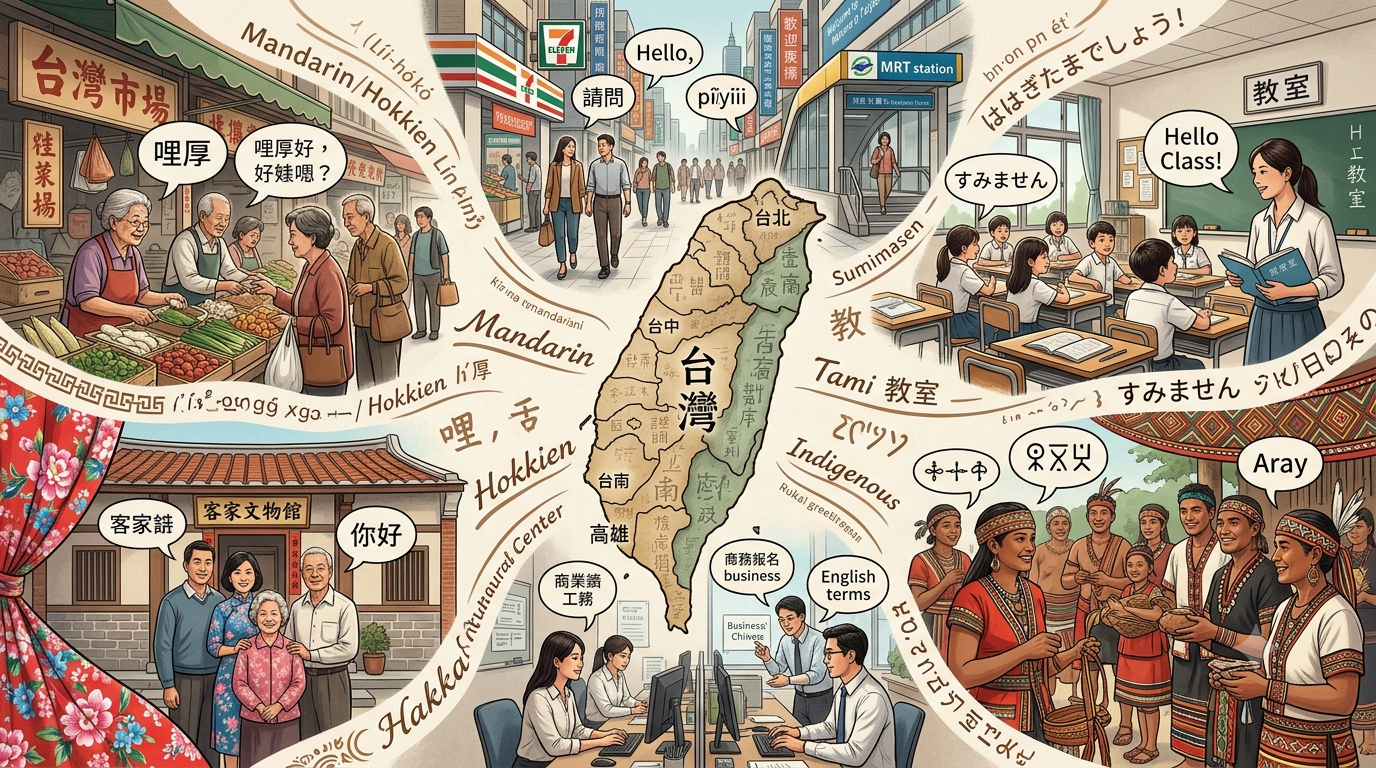

Taiwan speak is officially multilingual. Mandarin Chinese (Guoyu) functions as the main language of government schools and business and is used at home by roughly 8 in 10 households.
Taiwanese Hokkien spoken by around 70% of the population remains the everyday language of southern cities night markets and family life. Hakka is spoken by a smaller community concentrated in places like Miaoli and Hsinchu while 16 officially recognized Indigenous groups speak their own Austronesian languages.
Japanese still lingers among older generations from the colonial period and English is taught nationwide but spoken fluently by only a minority. Since 2019 Mandarin Hokkien Hakka the Formosan languages and Taiwan Sign Language have all held equal legal status as “national languages.”
Taiwan’s Language Landscape at a Glance
- Mandarin Chinese the dominant language of formal life spoken or understood by nearly everyone
- Taiwanese Hokkien the majority home language especially outside Taipei
- Hakka a distinct heritage language tied to specific regions
- Formosan (Indigenous) languages 16 recognized languages belonging to the Austronesian family
- Japanese a lingering influence from 50 years of colonial rule
- English widely studied unevenly spoken
- Taiwan Sign Language and immigrant languages smaller but legally recognized parts of the mix
No single one of these tells the whole story on its own. A person in Taiwan might use two or three of them before lunch in Mandarin at the office Hokkien with a market vendor and a few words of Japanese with a grandparent.
Mandarin: The Language of Government School and Business
Mandarin became Taiwan’s dominant language after 1945, when the island came under Republic of China administration following Japanese rule.
It was quickly made the main language of schools, official documents, and public life, while Hokkien, Hakka, and Indigenous languages were discouraged and sometimes restricted.
As a result, Mandarin is now understood by nearly everyone, though this came at a cost to Taiwan’s other languages.
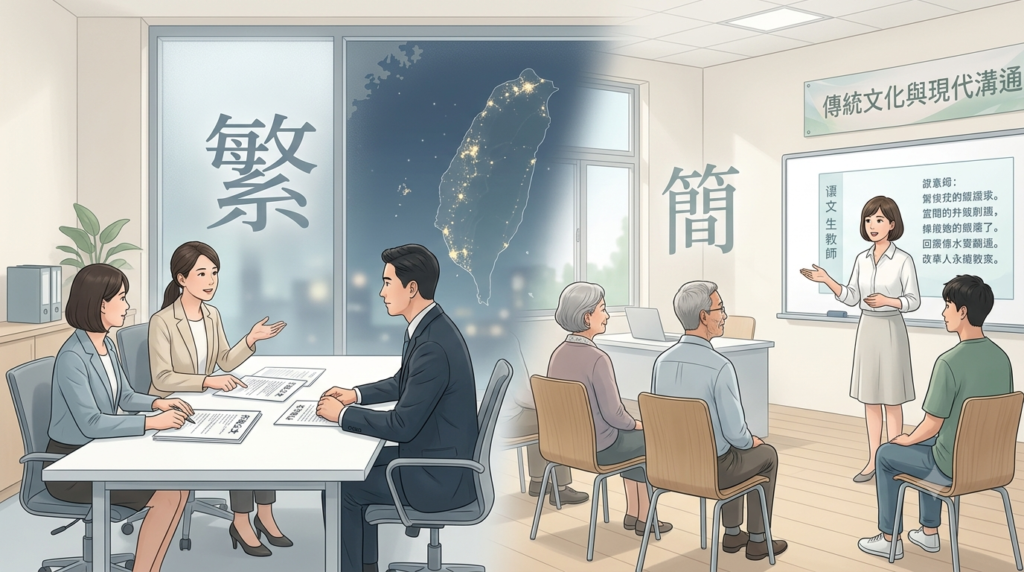
Taiwanese Mandarin isn’t identical to Mainland Mandarin. The two are mutually understandable but they diverge in a few concrete ways:
- Script: Taiwan uses Traditional Chinese characters; Mainland China uses Simplified Chinese.
- Vocabulary: everyday words differ a taxi is commonly 計程車 in Taiwan versus 出租車 on the Mainland.
- Tone and accent: Taiwanese Mandarin tends to sound softer and more rounded, an effect often credited to decades of contact with Hokkien.
For anyone producing content marketing material or translations for a Taiwanese audience mixing up Simplified characters with Traditional ones is one of the fastest ways to signal that the content wasn’t made with Taiwan specifically in mind.
Taiwanese Hokkien: The Language of Everyday Life
Taiwanese Hokkien commonly called Taiwanese is a Southern Min language brought by settlers from Fujian during the Qing dynasty. Over time it developed its own vocabulary rhythm and identity distinct from Mandarin.
Hokkien has more tonal variation than Mandarin commonly described as seven or eight tones compared with Mandarin’s four. Around seven in ten people in Taiwan speak it particularly in family life, night markets, temples and central and southern cities such as Tainan and Kaohsiung.
However younger generations increasingly understand Hokkien without speaking it fluently which is why schools now teach local languages with Hokkien being a common choice.
Hakka: A Distinct Regional Language
Hakka is a distinct language not a Mandarin dialect or Hokkien variety with its own grammar and sound system. Around one in ten to one in six people in Taiwan has Hakka heritage although fluent speakers are fewer and declining across generations.
Hakka communities are concentrated in areas such as Miaoli and Hsinchu with Sixian and Hailu among the most widely spoken varieties.
Taiwan supports Hakka preservation through education broadcasting cultural programs and the Hakka Affairs Council while Hakka also holds national language status.
Formosan Languages: Taiwan’s Original Voices
Taiwan’s Indigenous peoples have spoken Austronesian languages for thousands of years making the island especially important to the history of the Austronesian language family.
Taiwan officially recognizes 16 Indigenous groups including Amis Atayal Paiwan and Bunun each with its own linguistic heritage.
Only a minority of Indigenous people still speak their ancestral languages fluently and several are critically endangered.
Revitalization efforts include Indigenous language education broadcasting and teaching systems but preserving some languages remains an urgent challenge.
Japanese: A Legacy of Colonial Rule
Taiwan was under Japanese colonial rule from 1895 to 1945 during which Japanese became a major language of education and administration while local languages were restricted.
Many older Taiwanese who grew up during this period still speak Japanese and Japanese loanwords influenced everyday Mandarin and Hokkien.
Today Japanese also remains popular among professionals and younger Taiwanese because of business travel, anime, manga and Japanese culture.
English: Widely Taught Unevenly Spoken
English is taught throughout Taiwan’s education system but fluency varies by region, education and personal background. People in Taipei and other major cities with greater international exposure are generally more likely to speak it comfortably.
English remains important for education, international business technology travel and career opportunities.
This has also helped make private English learning centers common as students and professionals seek stronger language skills for study and employment.
The Smaller Pieces of the Puzzle
A few other languages round out Taiwan’s linguistic picture and each one has legal recognition even though the number of speakers is small:
- Taiwan Sign Language used by the island’s Deaf community and formally recognized as a national language.
- Immigrant languages Vietnamese Indonesian Thai and Tagalog in particular spoken by growing communities of migrant workers and spouses especially from Southeast Asia.
- Matsu language is a Min Dong variety spoken on the Matsu Islands which also carries national language status.
Why Taiwan Now Treats All of These as “National Languages”?
For decades Mandarin had the most legal and practical importance in Taiwan while other languages faced restrictions.
The 2019 Development of National Languages Act changed this by giving Mandarin Hokkien Hakka Formosan languages Matsu and Taiwan Sign Language equal legal recognition.
This allows these languages to be used in government and courts, receive public support for education and broadcasting and be taught through Taiwan’s mother tongue education programs.
However, limited teachers’ family preferences for Mandarin or English and weak digital support still make it difficult for younger generations to use minority languages regularly.
The Numbers Side by Side
| Language | Approximate reach | Where it’s strongest |
| Mandarin | Understood by nearly the entire population | Government schools media nationwide |
| Taiwanese Hokkien | ~70% of the population | Southern and central Taiwan night markets older generations |
| Hakka | Roughly one in ten to one in six residents | Miaoli Hsinchu parts of Pingtung Hualien Taoyuan |
| Formosan (Indigenous) languages | Around 1–2% at home | Tribal and rural areas |
| Japanese | Mainly older generations plus business/cultural learners | Nationwide generational |
| English | Taught nationwide comfortable fluency in a minority | Urban centers younger and educated groups |
Why This Isn’t Just a Trivia Question?
Language in Taiwan carries more weight than it might elsewhere because of how directly it’s tied to identity and political history. Mandarin represents official practical national life. Hokkien and Hakka carry generational memories and regional belonging.
The Formosan languages preserve a history that predates every other language on the island. Japanese and English both point outward toward global connection rather than local roots.
None of these languages is disappearing overnight and none of them is likely to fully replace another. What’s changing is the balance between them and how deliberately Taiwan chooses to protect the ones that came under the most pressure in the twentieth century.
FAQs
What is the official language of Taiwan?
Taiwan has no single official language by law. Mandarin (Guoyu) is the de facto language of government and education while Hokkien Hakka Formosan languages Matsu and Taiwan Sign Language are recognized as national languages.
Is Taiwanese the same as Mandarin?
No. Taiwanese Hokkien is a distinct Southern Min language with its own grammar vocabulary and tones so Mandarin speakers generally cannot understand it without learning it.
How many Indigenous languages does Taiwan have?
Taiwan recognizes 16 Indigenous groups each with its own Austronesian language including Amis Atayal Paiwan and Bunun. Several are endangered.
Do people in Taiwan speak Japanese?
Yes, Some older Taiwanese learned Japanese during the 1895–1945 colonial period while younger people and professionals may learn it for business or cultural interests.
Is English widely spoken in Taiwan?
English is widely taught but fluent speakers are a minority particularly outside urban and highly educated groups.


 By
By
 By
By
 By
By

 By
By