
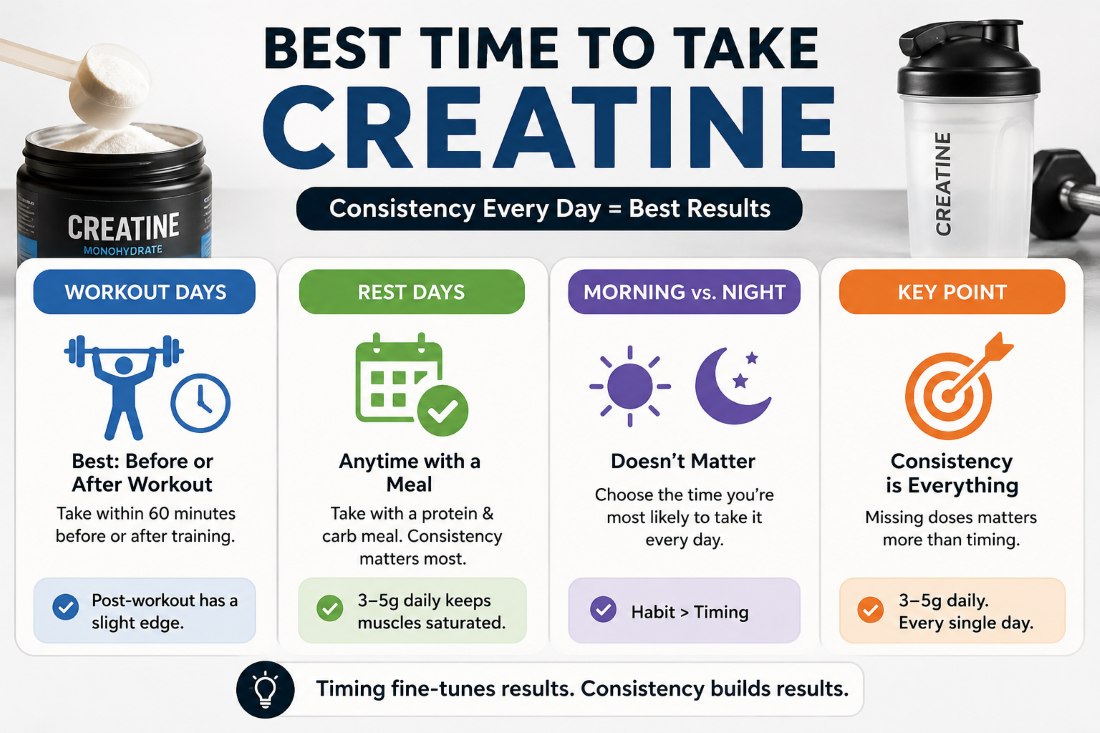

The best time to take creatine is consistently every single day. Muscle saturation is what drives results and missing doses undermines that more than any timing decision ever could.
That said there are specific scenarios where timing genuinely does produce a measurable edge and understanding them means you are not leaving performance on the table.
This guide covers every situation: workout days, rest days morning versus night bedtime women specific considerations, the weight gain question nobody answers clearly and what the emerging research says about creatine alongside GLP 1 medications.
Timing Matters Less Than You Think
Creatine works by gradually saturating your muscle phosphocreatine stores. With consistent daily intake of 3–5g full saturation typically occurs in about 28 days.
Once these stores are full your body uses them during high intensity exercise regardless of when you last took your dose.
This is why daily consistency is far more important than exact timing. A 2021 review in Nutrients confirmed that total daily intake is the main factor influencing muscle creatine levels while timing plays only a secondary role.
Think of it like this: a full fuel tank performs the same whether it was filled yesterday or this morning. Timing only becomes slightly relevant for fine tuning, not for building the foundation.
Key Takeaway: Taking 3–5g daily consistently builds and maintains creatine stores. Timing offers only marginal benefits.
Before or After a Workout: What Research Actually Shows!

This is the main question most people are trying to answer. The honest conclusion is that research is very close but post workout timing shows a slight and more consistent advantage in direct comparisons.
Pre Workout Creatine
Taking creatine 60–120 minutes before training allows it to be absorbed into the bloodstream by the time you begin exercising. A 5g dose typically takes 1–2 hours to fully pass through digestion and reach peak levels in the blood.
Once training starts exercise increases blood flow to working muscles (exercise hyperaemia) helping deliver circulating creatine directly into active muscle cells.
This makes pre workout timing a reasonable option especially for people who train in the morning or cannot take creatine after training.
Post Workout Creatine
Post workout timing has a slight edge because it uses the same blood flow mechanism when it is most elevated after training. Depending on intensity muscle blood flow stays high for 30–120 minutes after exercise.
Taking creatine during this window means it is delivered to muscles that are already activated and highly receptive to nutrients.
A 2013 study in the International Journal of Sport Nutrition and Exercise Metabolism found that men taking 5g creatine after resistance training gained more lean mass and strength compared to those taking it before training over four weeks.
A 2021 review also noted that post workout timing may offer a slight advantage although the effect is small and not consistent across all studies.
Best Time to Take Creatine on Rest Days
On non training days timing is largely irrelevant. The goal is simply to maintain fully saturated muscle stores which a consistent 3–5g daily dose achieved whether taken in the morning or evening.
The main practical guideline is to take creatine with a meal that includes both protein and carbohydrates. The Australian Institute of Sport recommends pairing it with around 50g of protein and 50g of carbohydrates. This is because carbohydrates increase insulin levels which helps enhance creatine transport into muscle cells while protein supports muscle protein synthesis.
In practice you can take creatine with any main mealbreakfast lunch or dinnerwhichever fits your routine best. On rest days consistency matters far more than precise timing.
Morning vs. Night: Does It Actually Matter?
A common question is whether creatine should be taken in the morning or at night. In reality neither timing is meaningfully better on its own.
Morning dosing has one practical advantage: it anchors creatine intake to a daily habit (breakfast coffee morning routine) that many people find easier to maintain. Habit anchoring dramatically improves supplement consistency which as established is the single most important variable.
Night dosing has no documented disadvantage for muscle performance. There is a separate question about sleep (addressed below) but for muscle creatine saturation a bedtime dose performs identically to a morning one.
Choose whichever time you are most likely to take it every day. That is the correct answer and it is not a cop out it is what the research supports.
Can You Take Creatine Before Bed?
To answer this properly we need to look at two things: muscle effectiveness and sleep impact.
Step 1: Effect on muscle creatine levels
There’s no issue here. Taking creatine before bed maintains muscle saturation just as effectively as taking it at any other time of day.
Step 2: Effect on sleep quality
Creatine contains no stimulants and does not disrupt sleep like caffeine. However research is slightly nuanced.
Step 3: What research suggests
A 2023 study in Scientific Reports found that a single large dose (similar to a loading dose) taken close to bedtime may temporarily reduce slow wave sleep in some individuals.
Step 4: What happens at normal doses
At standard maintenance doses of 3–5g this effect has not been consistently observed. Most people report no sleep disruption.
Step 5: Practical adjustment if needed
If you notice sleep changes shift your dose to the morning or midday and reassess.
Step 6: Emerging benefit
New research (2024 journal Sleep) suggests creatine may support brain energy metabolism and improve cognitive recovery after sleep deprivation.
Best Time to Take Creatine for Women
Women have lower baseline muscle creatine storesaround 70–80% of men’s levelsso the relative benefits of supplementation are at least equal and possibly greater. A 2021 Nutrients review found improvements in lean mass strength and cognitive function in women.
In terms of timing the same principle applies as for men: take creatine close to workouts ideally with protein and carbohydrates to support absorption.
Hormones add another layer. Oestrogen affects muscle recovery and protein synthesis and these fluctuate across the menstrual cycle. Some evidence suggests creatine utilisation may be slightly more efficient during the follicular phase (days 1–14) than the luteal phase.
However this doesn’t require changing your dosing schedule. Consistency is still the most important factor. These hormonal shifts may simply explain why performance feels stronger at certain times of the month.
For women who are pregnant or breastfeeding creatine has not been sufficiently studied. It’s best to consult a healthcare professional before use.
Why Did I Gain 10 Pounds After Taking Creatine?
This is a common concern for new users though often overlooked. Creatine pulls water into muscle cells increasing intracellular water retention. During the loading phase (20–25g daily for 5–7 days) gaining 1–3 kg (2–7 lbs) in the first week is normalsome may gain slightly more.
This is not fat gain or typical bloating. It reflects increased muscle hydration which supports better performance protein synthesis and efficiency.
The key factor is the loading phase which speeds up saturation and water retention. To avoid rapid weight gain skip loading and take 3–5g daily. Muscle stores will fully saturate in 3–4 weeks instead of 1 with a more gradual change on the scale.
What to Take Creatine With and What to Avoid
The AIS recommends taking creatine with a meal containing ~50g protein and ~50g carbs to improve absorption through insulin response.
What to avoid combining with creatine in the same dose:
- High doses of caffeine: A study in the Journal of Applied Physiology found that co-ingesting caffeine with creatine attenuated creatine’s performance benefits in sprinting tasks. The mechanism is not fully understood but the antagonistic effect is documented. Spacing caffeine and creatine at least an hour apart is a reasonable precaution.
- Alcohol: Alcohol consumption post training impairs muscle protein synthesis and may interfere with the recovery processes creatine is designed to support. Taking creatine with alcohol does not chemically deactivate it but the combination undermines the results you are supplementing for.
- Diuretics: Any compound that increases urine output can reduce creatine retention. If you take prescription diuretics, speak with your doctor before supplementing.
Creatine and GLP 1: What You Need to Know
“Should I take creatine while on GLP 1?” is a common question among users of medications like semaglutide (Ozempic Wegovy) or tirzepatide (Mounjaro) for weight loss.
GLP 1 drugs reduce calorie intake which supports fat loss but can also lead to muscle loss. Creatine is one of the few supplements with strong evidence for helping preserve lean muscle during a calorie deficit.
There are no known negative interactions between creatine and GLP 1 medications. While specific research is limited creatine may help counter muscle loss during GLP 1 assisted weight loss.
If you’re using GLP 1 focus on resistance training and adequate protein intake. Adding creatine (3–5g daily) can support muscle retention. Take it with meals and around workouts.
Always consult your doctor before adding any supplement.
The Loading Phase: Does Timing Matter More Early On?

During a creatine loading phase 20–25g daily split into four or five 5g doses across the day for 5 to 7 days timing across the day is less about workout proximity and more about distribution.
Spreading doses evenly (with meals throughout the day) maximises absorption because the creatine transporter becomes temporarily saturated with large single doses. Multiple smaller doses consumed with food throughout the day outperform two large doses in terms of uptake efficiency.
Once you transition to a maintenance dose of 3–5g daily the distribution question disappears. One dose taken consistently does the job.
FAQs
What time of day is best to take creatine?
There’s no universal best time. On training days take it within 60 minutes before or after workouts for a slight benefit due to increased blood flow. On rest days take it with a protein carb meal. Consistency matters most.
Is it better to take creatine before or after a workout?
Both work but post workout has a slight edge. A 2013 study showed greater strength and lean mass gains when taken after training. Still the difference is smalleither is better than taking it far from workouts.
Can I take creatine before bed?
Yes 3–5g doses don’t typically affect sleep. Large loading doses may impact sleep in some cases. If sleep issues occur, switch to morning or midday.
What is the best time to take creatine for women?
Same as mentake it close to workouts with protein and carbs. Women may benefit equally or more due to lower baseline creatine levels. Daily consistency is key despite hormonal variations.
Why did I gain weight after starting creatine?
It’s water retention in muscles not fat. Gaining 1–3 kg during loading is normal. Starting with 3–5g daily avoids rapid weight changes while giving the same long term results.

 By
By



 By
By