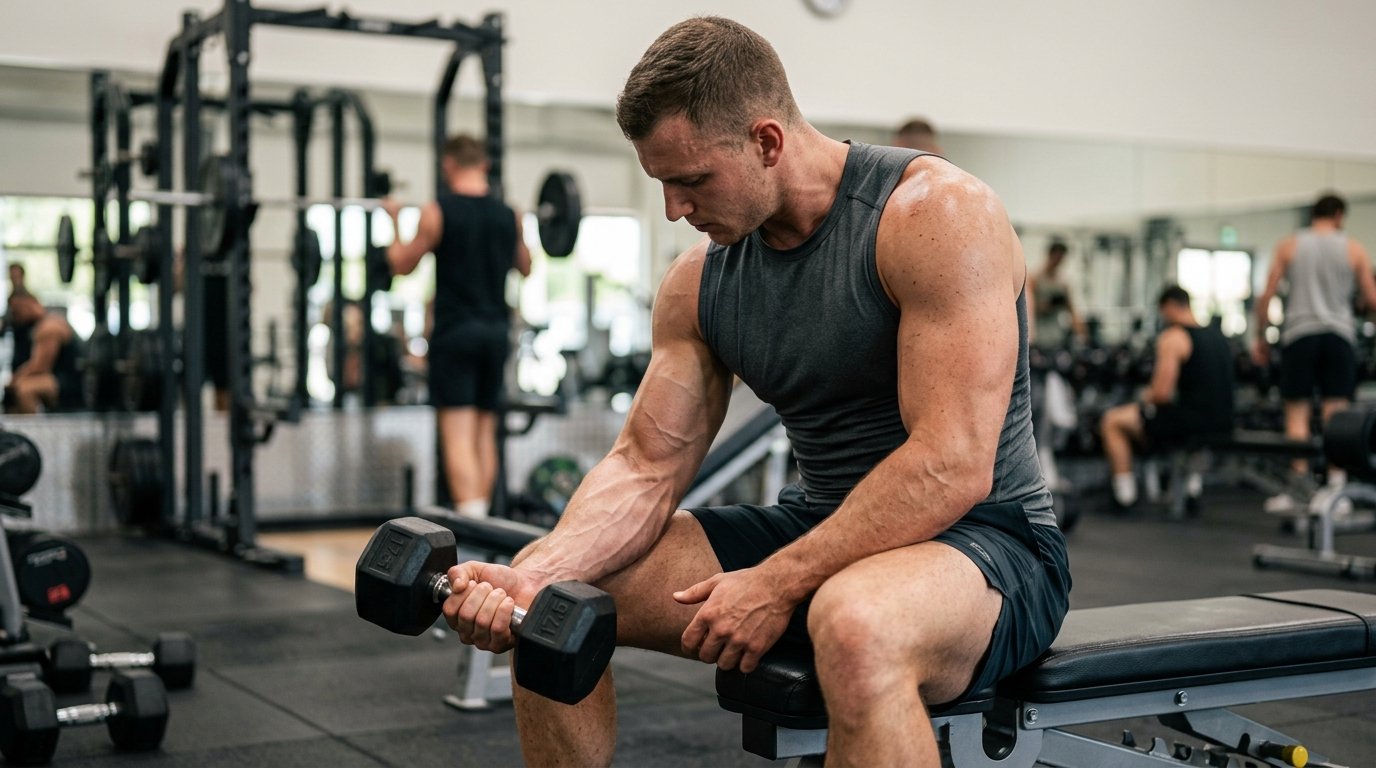

If your deadlift pull ups or farmer’s carries keep getting cut short because your grip gives out first your forearms are the missing link. The good news: you don’t need a cable machine or a specialty gripper to fix it.
A simple pair of dumbbells is enough to build thicker, stronger, more resilient forearms whether you’re training at home or in the gym.
This guide breaks down forearm anatomy the 12 best dumbbell forearm exercises ready to use weekly routine common mistakes and answers to the questions people actually search for.
Key Takeaways
- Forearm workouts with dumbbells strengthen your wrist flexors, wrist extensors and brachioradialis, the three muscle groups responsible for grip strength and forearm size.
- You only need 2–3 focused sessions per week of 10–15 minutes to see real strength and size gains.
- A well rounded routine trains wrist flexion wrist extension elbow flexion and static grip not just wrist curls.
- Stronger forearms directly carry over to deadlifts, pull ups rows and any sport involving a racket bat or ball.
Forearm Anatomy: What You’re Actually Training?
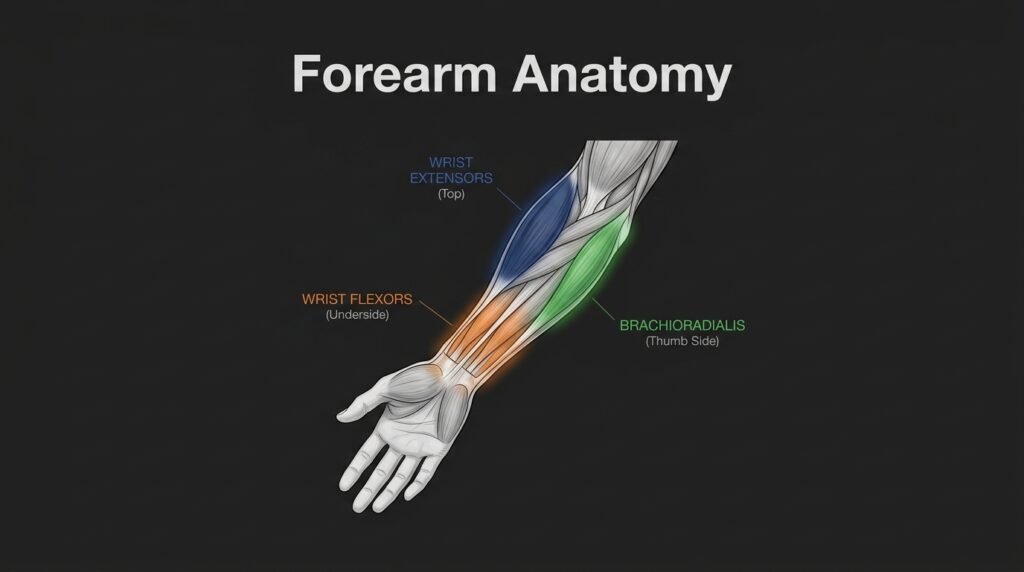
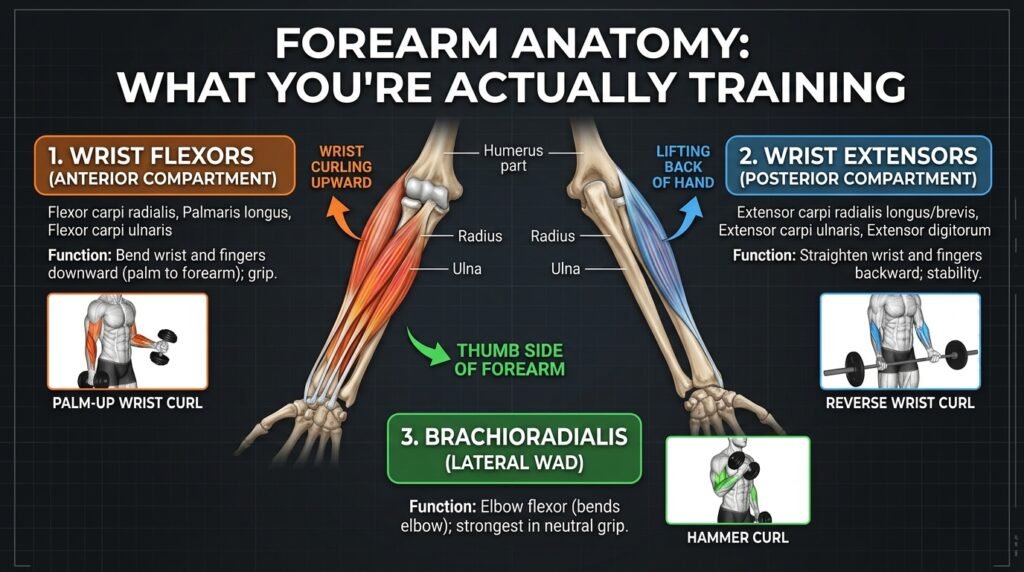
Your forearm isn’t one muscle; it’s made up of about 20 muscles that move your wrist, hand, and fingers. For training, focus on three key groups.
Wrist flexors are on the underside and curl your wrist upward, targeted by palm-up wrist curls. Wrist extensors sit on top and lift the back of your hand, trained with reverse wrist curls and wrist extensions.
The brachioradialis is the largest visible muscle along the thumb side. It doesn’t cross the wrist, so it grows through elbow flexion exercises like hammer curls and reverse-grip curls, not wrist curls alone.
A complete workout targets all three groups, but most people only do wrist curls, which limits forearm growth.
Benefits of Dumbbell Forearm Training
- Stronger grip for deadlifts pulls up rows and carries so your forearms stop being the weak link.
- Injury prevention stronger tendons and muscles around the wrist and elbow lower your risk of tendinitis and strains.
- Better sports performance in golf tennis climbing basketball and racquet sports where wrist and hand power matter.
- Balanced arm aesthetics well developed forearms make your whole arm look more proportionate, not just your biceps.
- Everyday function opening jars carrying groceries and hauling luggage all get easier.
Warming Up Before Forearm Exercises
Because the muscles here are small and used constantly, a proper warm up matters more than you’d think.
- Rotate your wrists in slow circles both directions 10–15 reps each way.
- Shake out your hands and gently stretch your fingers open and closed.
- Do 1–2 light warm up sets of wrist curls with just the dumbbell weight (no added resistance).
This increases blood flow and reduces the risk of strain before you load the joint.
The 12 Best Forearm Workouts With Dumbbells
Use light dumbbells to start (5–10 lb) and increase gradually. Every exercise should be taken close to failure to the point where you can no longer complete a rep with good form.
1. Palm Up Wrist Curl
Targets the wrist flexors.
- Sit and rest your forearms on your thighs or a bench palms facing up dumbbells in each hand.
- Let your wrists drop back as far as comfortable.
- Curl your hands upward as high as possible squeezing at the top.
- Lower slowly back to the start.
Sets/reps: 2–3 sets of 12–15 reps.
2. Palm Down Wrist Curl (Reverse Wrist Curl)
Targets the wrist extensors, the most commonly neglected forearm muscle.
- Rest your forearms on your thighs or a bench palms facing down.
- Lower the dumbbells slightly past the edge then lift your knuckles as high as you can.
- Pause then lower under control.
Sets/reps: 2–3 sets of 12–15 reps. Go lighter here extensors are weaker than flexors.
3. Hammer Curl
Builds the brachioradialis through elbow flexion adding forearm thickness and size.
- Stand tall holding a dumbbell in each hand palms facing your body (neutral grip).
- Curl both weights up toward your shoulders without rotating your wrists.
- Squeeze at the top then lower with control.
Sets/reps: 3 sets of 10–12 reps.
4. Zottman Curl
Trains the biceps on the way up and the forearms on the way down in a single rep.
- Curl the dumbbells up with palms facing you as in a normal bicep curl.
- At the top rotate your wrists so your palms face outward.
- Lower the weight slowly in this pronated position.
- Rotate back to supine and repeat.
Sets/reps: 2–3 sets of 10 reps.
5. Reverse Grip Curl
Isolates the brachioradialis and reduces bicep involvement.
- Hold dumbbells with an overhand grip (palms down) arms extended.
- Curl upward keeping elbows tucked to your sides.
- Pause near the top then lower slowly.
Sets/reps: 3 sets of 10–12 reps.
6. Wrist Extension (Single Arm)
Isolates the extensors for balanced forearm development.
- Rest your forearm on a bench with your wrist and hand hanging off the edge palm down.
- Hold a light dumbbell and lift your knuckles upward.
- Lower slowly then repeat.
Sets/reps: 2–3 sets of 12–15 reps per arm.
7. Farmer’s Carry
A functional grip and full body forearm builder.
- Hold a heavy dumbbell in each hand at your sides shoulders back core braced.
- Walk for 30–40 feet or 30–45 seconds keeping your grip tight throughout.
- Set the weights down and rest.
Sets/reps: 2–3 sets. For extra difficulty wrap a towel around the handles to thicken the grip.
8. Dumbbell Grip Crush
Builds crushing grip strength using just one dumbbell.
- Rest your wrist on your knee or a bench holding a dumbbell loosely so it rolls toward your fingertips.
- Curl your fingers and wrist to squeeze the weight back into your palm as tightly as possible.
- Release slowly and repeat.
Sets/reps: 2–3 sets of 10–15 reps per side.
9. Radial/Ulnar Deviation
An often skipped movement that trains side to side wrist strength useful for racket sports and golf.
- Hold a light dumbbell vertically at your side thumb pointing up (hammer grip).
- Without bending your elbow, tilt your wrist up toward your thumb then down toward your pinky.
- Move slowly through the full range.
Sets/reps: 2 sets of 12–15 reps per arm.
10. Seated Dumbbell Wrist Roll
A time under tension finisher for endurance and definition.
- Sit holding a dumbbell in one hand forearm resting on your thigh.
- Slowly rotate your wrist in small circles alternating clockwise and counter clockwise.
- Keep the movement slow and controlled throughout.
Sets/reps: 2 sets of 20 seconds per direction per arm.
11. Dumbbell Dead Hang Hold
Builds static grip endurance without a pull up bar and uses a heavy dumbbell instead.
- Hold a heavy dumbbell in one hand and relax at your side.
- Grip as tightly as possible and hold for time without letting it slip.
- Switch arms.
Sets/reps: 2–3 sets of 20–40 seconds per arm.
12. Dumbbell Wrist Circles (Cooldown/Burnout)
A light finisher that also doubles as a warm up.
- Hold a light dumbbell in each hand, arms extended in front of you.
- Rotate your wrists in slow circles 10 reps each direction.
Sets/reps: 1–2 sets at the end of your workout.
Sample Forearm Workout Routine With Dumbbells
You don’t need to do all 12 exercises every session. Rotate through this simple split 2–3 times a week resting at least one day between sessions.
| Day | Exercises | Sets x Reps |
| Day 1 (Flexion focus) | Palm Up Wrist Curl Hammer Curl Farmer’s Carry | 3 x 12–15 |
| Day 2 (Extension + Grip) | Palm Down Wrist Curl Wrist Extension Grip Crush | 3 x 12–15 |
| Day 3 (Mixed/Endurance) | Zottman Curl Reverse Grip Curl Dead Hang Hold | 2–3 x 10–15 |
Add this after your regular workout or as a short 10–15 minute standalone session on rest days.
How Often Should You Train Forearms?
2–3 sessions per week is enough for most people. Because forearm muscles are small and recover quickly you can train them more frequently than larger muscle groups but always leave at least one rest day between focused sessions so tendons can recover since these are more injury prone than muscle tissue.
Common Mistakes to Avoid
- Going too heavy too soon. Forearms respond better to control and full range of motion than to heavy weight start light.
- Only doing wrist curls. Without elbow flexion moves like hammer curls you’re skipping the brachioradialis, the muscle that makes forearms look bigger.
- Using momentum. Swinging the dumbbells reduces tension on the target muscle and keeps movements slow and deliberate.
- Skipping the extensors. Most people overtrain flexors and neglect extensors creating muscle imbalance and wrist strain risk.
- No warm up. Cold wrist tendons are more prone to irritation under load.
Cautions
Stop immediately if you feel sharp pain, mild muscle fatigue is normal joint pain is not. If you experience soreness afterward, ice the area and use gentle stretching.
If you have a history of wrist or elbow issues (like tennis elbow) check with a physical therapist or trainer before starting a new forearm routine.
The Bottom Line
Forearm workouts with dumbbells are one of the highest return additions you can make to your training. They take minutes, require minimal equipment and directly improve your performance in every pulling, carrying and gripping movement you do.
Train flexion extension and grip together 2–3 times a week keep your form controlled and your forearms will get stronger and more defined within a couple of months.
FAQs
How long does it take to grow forearms?
Visible growth usually takes around 8–12 weeks with consistent training 2–3 times per week along with proper protein intake and progressive overload.
Do dumbbell curls grow forearms?
Standard bicep curls have limited impact. Hammer curls and reverse grip curls are more effective as they directly target the brachioradialis.
Should I train my forearms with biceps or triceps?
Both work but pairing with biceps is more common since many forearm exercises involve elbow flexion.
What is the number one forearm exercise?
There isn’t a single best move. A complete routine should include wrist curls, reverse wrist curls and hammer curls for full development.

 By
By

 By
By