
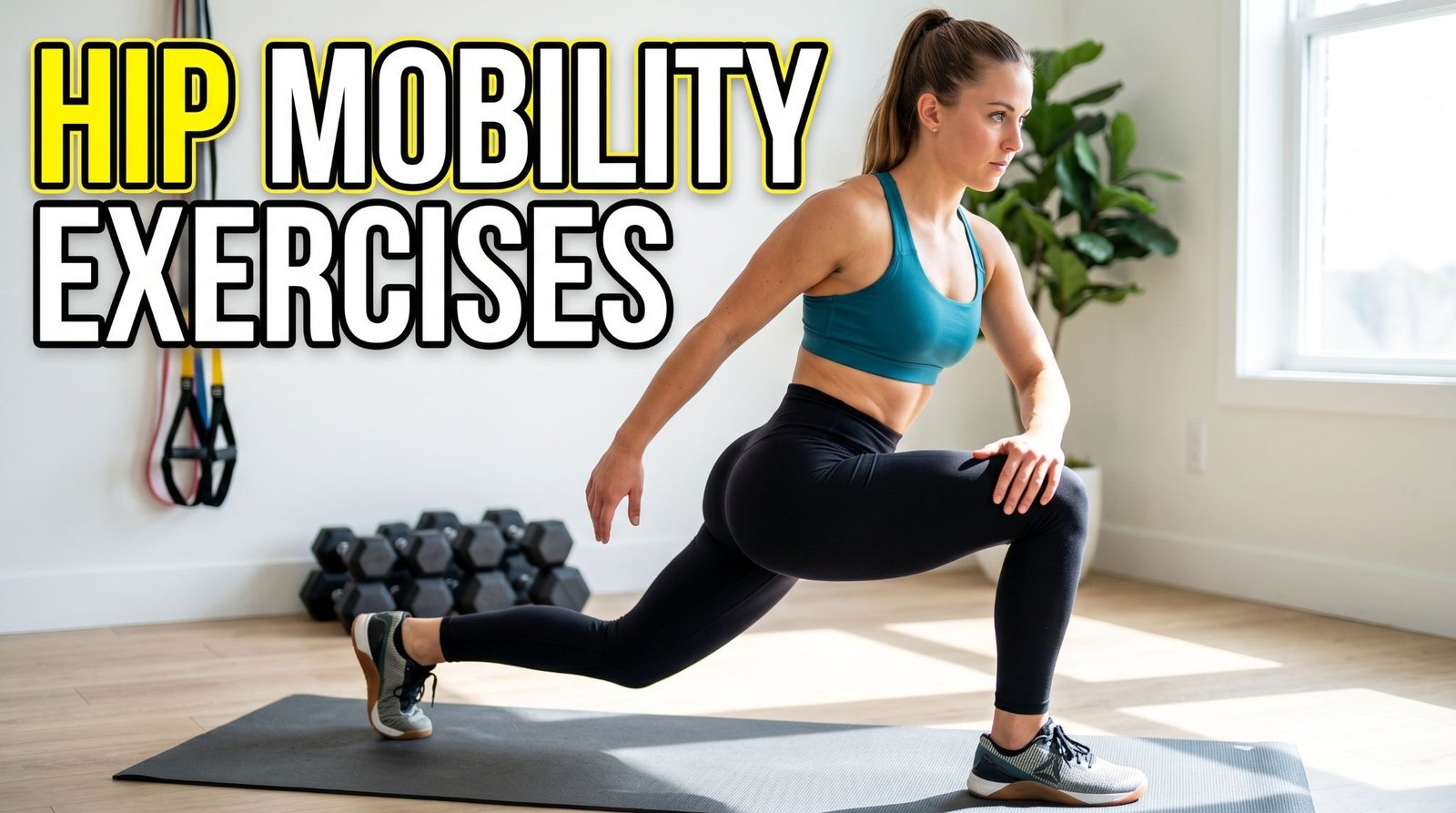

The five highest value hip mobility exercises are the 90/90 stretch, the world’s greatest stretch, the hip flexor lunge with the deep squat hold and quadruped hip circles. Performed daily for 10 minutes this short stack improves hip range of motion within two to four weeks for most people.
The full guide below adds five more exercises, a self assessment to find your tightest direction and a weekly routine that fits into a real schedule.
Most online lists hand you 10 exercises and walk away. This one tells you which ones you actually need in what order and when an exercise is making things worse rather than better.
Why Hip Mobility Matters More Than You Think?
Your hips are the second most mobile joint after the shoulders, and nearly every movement walking, squatting, rotating depends on them.
When hip mobility decreases, often due to prolonged sitting, the body compensates by shifting movement to the lower back and knees, leading to issues like chronic back and knee pain.
Research shows that sitting over six hours daily reduces hip internal rotation first, followed by extension and deep flexion.
As mobility declines, stress transfers to nearby joints. This is why many cases of back pain actually stem from poor hip function. Without proper mobility, strength and athletic performance also suffer.
Mobility vs. Flexibility vs. Stability
These three terms are not the same thing.
| Term | What it means? | How you train it? |
| Flexibility | Passive range of motion | Static stretching holds |
| Mobility | Active controlled range of motion | Dynamic stretches controlled rotations |
| Stability | Strength at end ranges of motion | Loaded movements isometric holds |
Most people training flexibility are only lengthening tissue without teaching the nervous system to control the new range. The exercises below build all three which is why this routine works when generic stretching does not.
How to Test Your Hip Mobility at Home?
Run these three tests before you train to find your weakest direction.
Deep Squat Test
Feet shoulder width toes slightly out. Squat as low as possible with heels flat. If heels lift or trunk falls forward you have an ankle and hip limitation.
90/90 Test
Sit with one leg bent 90 degrees in front and the other 90 degrees beside you. Try to lean forward over the front leg without lifting either knee. Inability signals limited rotation.
Couch Stretch Test
Shin on a couch behind you knee on the floor. Square your hips and try to stand tall. A sharp back arch or cramping in the front hip indicates restricted extension.
Whichever test feels worst is the direction to prioritize over the next four weeks.
What Are the 10 Best Hip Mobility Exercises for Flexibility and Strength?
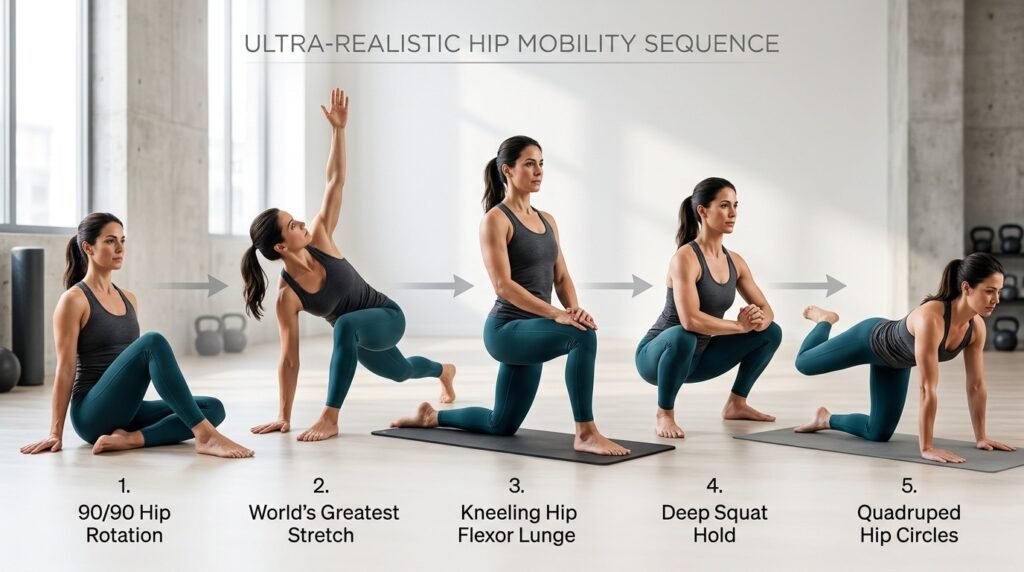
Each exercise targets a specific direction. Do not just rep through all ten — work the ones your assessment flagged
1. 90/90 Hip Switches
- Sit in the 90/90 position and rotate your knees from one side to the other without using your hands.
- Focus on controlled motion not speed.
- 3 sets of 8 switches per side.
- Targets hip rotation in both directions.
2. World’s Greatest Stretch
- From a high lunge place your front side hand inside the front foot.
- Reach the same side arm toward the ceiling rotating your trunk.
- 2 sets of 5 reps per side with a 2 second hold.
- Opens hip flexors and thoracic rotation simultaneously.
3. Deep Squat Hold
- Drop into a full squat feet shoulder width apart.
- Use your elbows to gently push your knees out.
- 2 minutes total broken into 30 second holds.
- Builds end range tolerance in hip flexion.
4. Hip Flexor Lunge with Reach
- Half kneeling position with back knee on a soft surface.
- Squeeze the back glute hard then reach the same side arm overhead and slightly opposite.
- 3 sets of 8 reps per side with a 2 second hold at the top.
- Targets hip extension restricted by prolonged sitting.
5. Quadruped Hip Circles (CARs)
- On all fours lift one knee and trace the largest circle possible without shifting your pelvis.
- Move slowly and with control.
- 3 circles forward 3 backward each side.
- Trains active range of motion through the full hip socket.
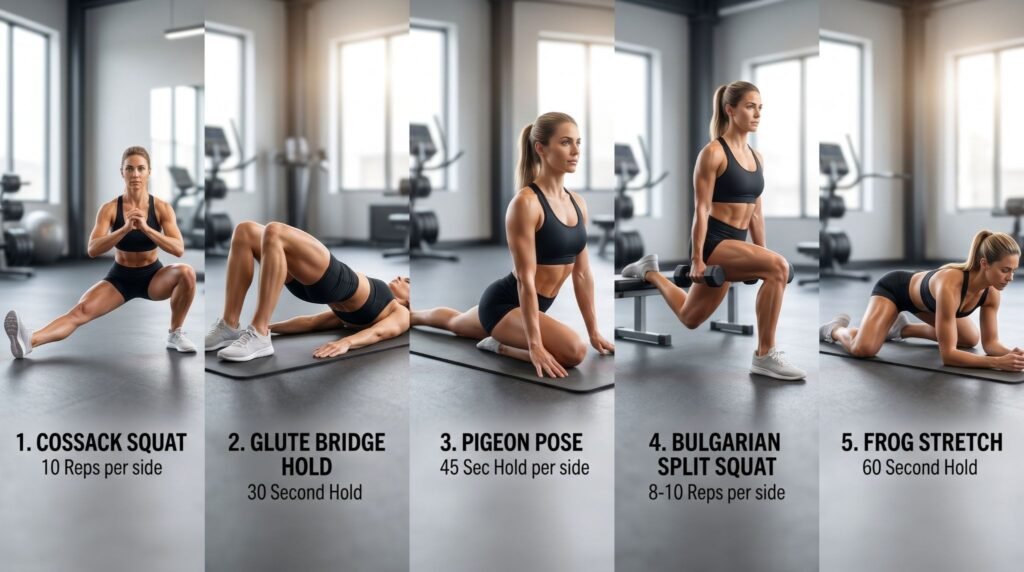
6. Cossack Squat
- Wide stance. Shift weight to one side and bend that knee while keeping the other leg straight.
- Foot of the straight leg stays flexed up.
- 2 sets of 6 reps per side.
- Builds frontal plane mobility which most routines ignore.
7. Glute Bridge with Hold
- Lie on your back, feet flat, knees bent. Drive through heels and lift hips.
- Hold at the top with a full glute squeeze for 3 seconds.
- 3 sets of 10 reps.
- Trains hip extension under load the strength side of mobility.
8. Pigeon Pose with Active Engagement
- Bring one knee forward toward the same side wrist shin angled across.
- Keep hips square and gently press the front shin into the floor rather than collapsing.
- Hold for 60 seconds per side.
- Targets external rotation.
9. Bulgarian Split Squat (Bodyweight)
- Rear foot on a low bench, front foot a stride forward.
- Drop the back knee toward the ground keeping the torso upright.
- 2 sets of 8 reps per side.
- Builds single leg hip strength at depth.
10. Frog Stretch
- Kneel with knees wide ankles in line with knees shins flat.
- Push hips back slowly toward your heels until you feel an inner thigh stretch.
- Hold for 60 seconds 2 rounds.
- Opens deep adductors that limit squat depth.
Hip Mobility Exercises for Desk Workers
If you sit six or more hours daily your hips lock into a flexed and internally rotated position. The fix is not just stretching the hip flexors — it is reactivating the glutes that have switched off.
- Daily minimum (10 minutes): 90/90 hip switches deep squat hold hip flexor lunge quadruped CARs.
- 3 times per week (20 minutes): Add Cossack squats Bulgarian split squats glute bridges world’s greatest stretch.
- 2 times per week (5 minutes): Add pigeon pose and frog stretch as longer holds.
Always sequence dynamic exercises before static holds. Cold tissue does not respond well to deep stretching. Expect noticeable change in three weeks. Lasting structural improvement takes 8 to 12 weeks.
Hip Mobility for Desk Workers
If you sit six or more hours daily your hips lock into a flexed position. The fix is not just stretching hip flexors but reactivating the glutes that have switched off.
- Every 60 minutes: Stand and do 5 hip flexor lunges per side without leaving your workspace.
- Morning: Glute bridges 2 sets of 15 to wake up the glutes before sitting.
- End of workday: 2 minute deep squat hold.
- Before bed: Pigeon pose and frog stretch 90 seconds each.
This takes under 12 minutes spread across the day and beats a 60 minute session done once a week and abandoned.
Common Mistakes That Make Hip Mobility Worse
- Forcing depth too fast: Pushing into a position your nervous system does not trust triggers protective tension. Progress in small increments.
- Stretching cold: Deep static stretching before warming up raises the risk of strain sharply.
- Ignoring asymmetry: If one side is tighter do extra reps on that side until they match.
- Confusing pain with stretch: Sharp pain in the front of the hip or groin is not productive. Stop and reassess.
- Skipping strength: Mobility without strength at end range is unstable. Always include the strength exercises.
FAQs
How long does it take to improve hip mobility?
Most people see noticeable improvement within 2–4 weeks of daily practice. Long-term structural changes typically take 8–12 weeks, or up to 16 weeks for those with prolonged sitting habits.
Can I do hip mobility exercises every day?
Yes. Mobility training is low impact and recovery-friendly. Short daily sessions are more effective than occasional long workouts because consistency helps the body retain new range.
Why are my hips tight even though I stretch?
Static stretching improves flexibility but not active control. The body won’t release range and it can’t stabilize. Adding strength exercises at end ranges helps unlock persistent tightness.
What is the best hip mobility exercise for sciatica?
The 90/90 hip switch and active pigeon pose are commonly used as they target external rotation and piriformis tension. If pain radiates below the knee or includes numbness, consult a professional first.
This article is for informational purposes only. Consult a qualified healthcare professional before starting any new exercise programme.

 By
By


 By
By