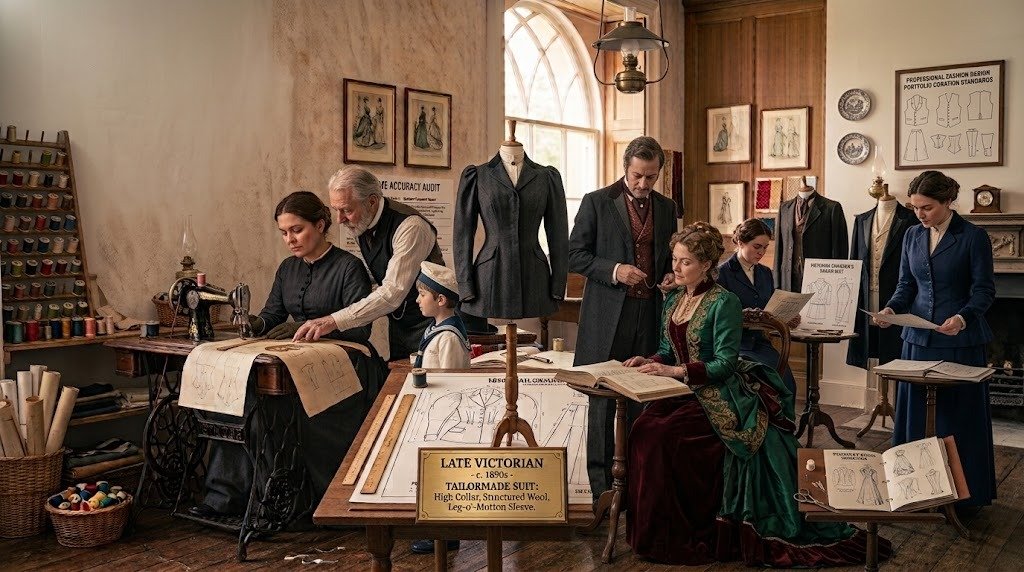

Victorian era outfits changed throughout Queen Victoria’s reign from 1837 to 1901. Women’s clothing evolved through full skirts, crinolines, bustle dresses and the large sleeves of the 1890s.
Men’s and children’s clothing also varied according to age, occupation, social class and occasion. A formal gown, a working man’s everyday clothes and a child’s outfit served different purposes.
This guide explores Victorian clothing styles and explains how to identify historically appropriate outfits without mixing details from different decades.
What Were Victorian Era Outfits?
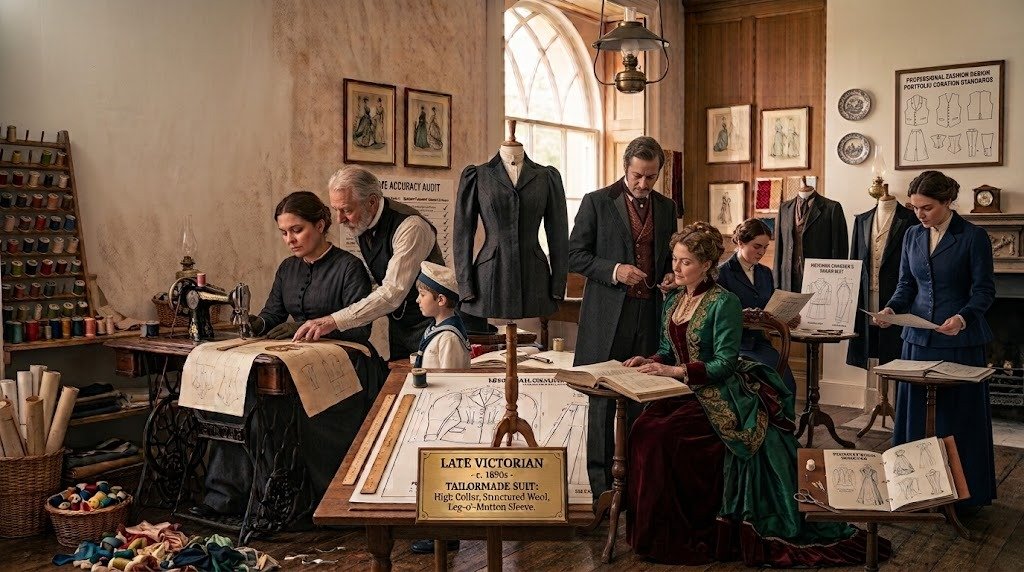
Victorian era outfits were the clothing and accessories worn during Queen Victoria’s reign. They included everyday wear formal clothing workwear outdoor outfits and garments for social occasions.
There was no single Victorian style. Clothing differed according to income age, occupation location and personal circumstances. Wealthier people could afford more outfits while many working people needed durable clothing that could be repaired and worn repeatedly.
Fashion also changed over time. The wide skirts of the 1850s and 1860s differed from the bustle styles of the 1870s and 1880s and the prominent sleeves of the 1890s.
How Did Victorian Outfits Change Over Time?
The silhouette is a useful starting point when identifying Victorian clothing.
| Period | Women’s Clothing | Recognizable Features |
| 1837–1849 | Fitted bodices and full skirts | Sloping shoulders shaped sleeves |
| 1850s–1860s | Very wide skirts | Cage crinolines and broad silhouettes |
| 1870s | Rearfocused skirt volume | Draped overskirts and early bustles |
| 1880s | Structured or elongated silhouettes | Pronounced bustles and fitted dresses |
| 1890s | Simpler skirts and prominent sleeves | Gigot sleeves shirtwaists fitted bodices |
These are general trends rather than strict rules. Men’s and children’s clothing also evolved although not always in the same way as women’s fashion.
What Did Women Wear in the Victorian Era?
Victorian women’s outfits often included a fitted bodice, a long skirt and undergarments that helped create the fashionable silhouette. The exact design depended on the decade occasion and available budget.
Day dresses: Usually featured higher necklines and long sleeves with decoration ranging from simple to elaborate.
Walking costumes: Designed for outdoor activities and visits often combining a skirt with a fitted bodice or jacket.
Evening gowns: Often featured lower necklines, decorative fabrics and more elaborate details than daytime clothing.
Tea gowns: Informal indoor garments that could offer a more relaxed alternative to formal dresses.
Corsets Petticoats and Skirt Supports
Corsets helped shape the torso and support fitted bodices. Petticoats added volume warmth and coverage beneath skirts.
The cage crinoline became fashionable in the 1850s and supported wide skirts with hoops. Bustles popular during parts of the 1870s and 1880s concentrated more of the skirt’s volume at the back. These garments created different silhouettes and should not be treated as interchangeable.
What Did Victorian Men Wear?
Victorian men’s clothing generally included shirts, trousers, waistcoats , jackets and coats. The combination depended on the occasion, profession and decade.
- Frock coats: Formal or semiformal coats worn in various social and professional settings.
- Morning coats: Associated with formal daytime dress.
- Waistcoats: Worn over shirts and beneath coats or jackets.
- Top hats: Commonly associated with particular formal and urban settings.
- Trousers and boots: Used for everyday activities work travel and formal occasions.
Not every man wore formal suits daily. Working clothing varied considerably according to occupation and practical needs.
What Did Victorian Children Wear?
Children’s clothing depended on age, family income and occasion. Wealthier families could afford special outfits while others relied on practical garments that could be repaired or passed down.
Young children wore clothing suited to their age. As they grew older their outfits increasingly reflected contemporary expectations about gender and social behavior.
Boys might wear shirts, jackets, trousers or sailorstyle outfits. Girls commonly wore dresses with skirts and bodices. Styles varied considerably throughout the Victorian period so children’s outfits should not be treated simply as smaller versions of adult formalwear.
What Accessories Completed a Victorian Outfit?
Accessories could be both practical and decorative.
- Hats and bonnets: Varied by decade occasion and activity.
- Gloves: Worn for different social and formal occasions.
- Parasols: Provided sun protection and could be decorative.
- Boots and shoes: Included buttoned or laced boots and footwear for formal occasions.
- Jewelry: Brooches necklaces, earrings and other pieces completed many outfits.
- Bags and personal items: Varied according to the wearer’s needs and activities.
Accessories should match the outfit’s date and purpose. Details popular in the 1890s may look out of place with a dress inspired by the 1840s.
How Did Social Class Influence Victorian Clothing?
Social class influenced the quality of fabrics tailoring and the number of outfits a person could own. Wealthier people could afford skilled dressmakers and separate garments for different occasions.
Middle class wardrobes often balanced fashionable details with practical needs. Working people generally needed durable clothing that could be repaired and reused.
These differences were not absolute. People adapted fashionable styles to their budgets and elaborate clothing did not represent everyone’s everyday experience.
What Were Aesthetic Dress and the Second Bustle Period?
The second bustle period is associated with the middle and later 1880s when some fashionable dresses featured a pronounced projection at the back of the skirt. Structured supports and decorative fabric emphasized this shape.
Aesthetic Dress offered a different approach influenced by artistic ideas and a preference for flowing lines and less elaborate construction than some mainstream fashions.
These styles existed alongside each other. Aesthetic Dress did not replace mainstream fashion and the two represent different approaches to clothing and appearance during the late nineteenth century.
How Did Technology Change Victorian Outfits?
Sewing machines, textile manufacturing fashion publications and readymade clothing influenced how Victorian garments were produced and circulated.
Fashion illustrations helped spread new designs while sewing machines could speed up parts of garment construction. Improvements in production increased the availability of some clothing but income and access to skilled work continued to influence what people could afford.
How Can You Create or Identify a Historically Accurate Victorian Outfit?
Start by choosing a decade and occasion. A Victorian outfit for a formal event would look different from clothing intended for work or everyday activities.
- Choose a period: Decide which decade you want to represent.
- Identify the silhouette: Examine the skirt width sleeve shape and bodice construction.
- Consider the wearer: Age, occupation gender and social circumstances affected clothing.
- Match the occasion: Workwear daywear and eveningwear served different purposes.
- Select appropriate accessories: Choose hats, shoes, gloves and jewelry that suit the period.
- Check historical references: Compare your choices with dated museum garments and fashion illustrations.
Avoid combining features from unrelated decades. A cage crinoline, an exaggerated 1880s bustle and large 1890s sleeves do not represent one single fashionable silhouette.
Victorian Outfits vs. Edwardian Outfits
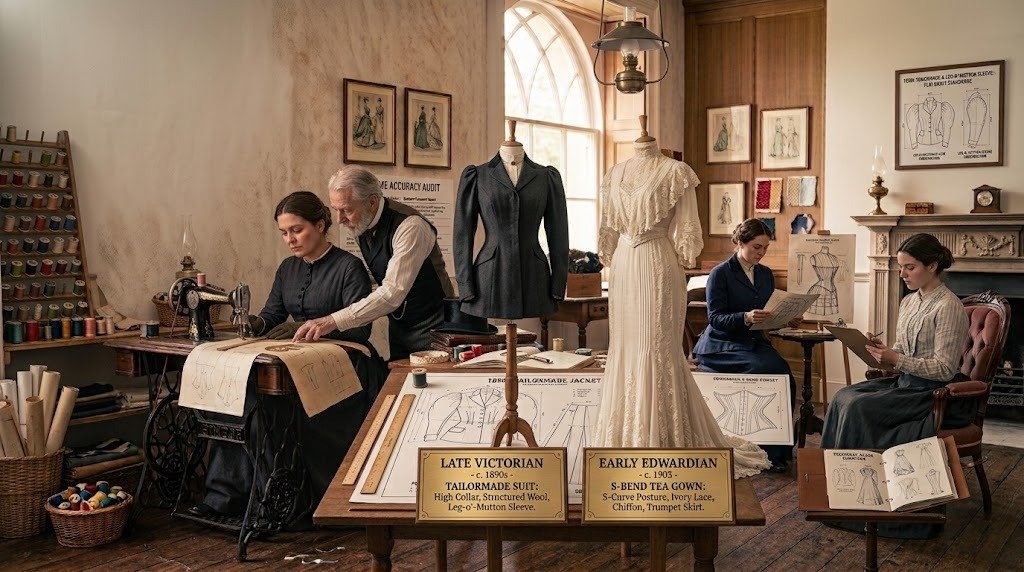
Victorian fashion ended with Queen Victoria’s reign in 1901. Edwardian fashion developed in the following period although the transition was gradual.
| Feature | Victorian Outfits | Edwardian Outfits |
| Period | 1837–1901 | Early twentieth century |
| Silhouettes | Changed from full skirts to bustles and later sleevefocused styles | Developed new flowing and shaped silhouettes |
| Clothing structure | Varied significantly by decade | Continued to evolve with new fashionable lines |
| Historical identification | Requires identifying the specific Victorian decade | Requires comparison with early twentieth century examples |
Some late Victorian styles continued into the early twentieth century. Accurate dating requires examining garment construction and historical documentation.
Conclusion
Victorian era outfits ranged from practical workwear to elaborate formal clothing. Their styles changed across the decades and reflected differences in age, occupation, social class and occasion.
For accurate historical research or costume planning choose a specific decade first. Then use dated references to guide the silhouette garment construction and accessories.
FAQs
What is a typical Victorian era outfit?
There was no single typical outfit for the entire period. Women’s clothing often included fitted bodices and long skirts while men’s outfits commonly included shirts, trousers, waistcoats and coats.
What did Victorian people wear every day?
Everyday clothing depended on occupation and circumstances. Many people wore practical garments for work while those with greater resources could change outfits for visits and formal events.
Did every Victorian woman wear a bustle?
No. Bustles were associated with particular periods, especially parts of the 1870s and 1880s. Other decades featured different skirt shapes.
What should I wear for a Victorian themed event?
Choose a specific decade if historical accuracy matters. Then select clothing and accessories that match its silhouette and the event’s purpose.
What is the difference between Victorian fashion and Victorian costumes?
Victorian fashion refers to historically worn clothing. Modern Victorian costumes may imitate period styles but combine details from different decades or simplify original construction.
Where can I research authentic Victorian outfits?
The Victoria and Albert Museum, the Fashion History Timeline at FIT and dated nineteenth century fashion illustrations are useful starting points for researching historical garments.

 By
By

 By
By